| | | Extraterrestrial Chemistry | | By Jeff Brown, Editor, The Bleeding Edge | | |
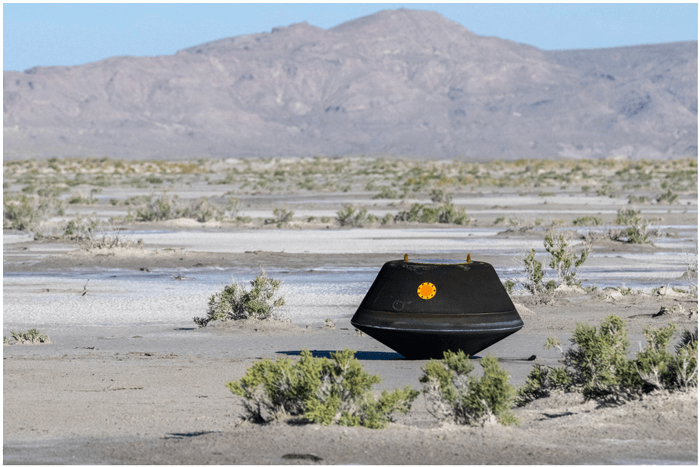
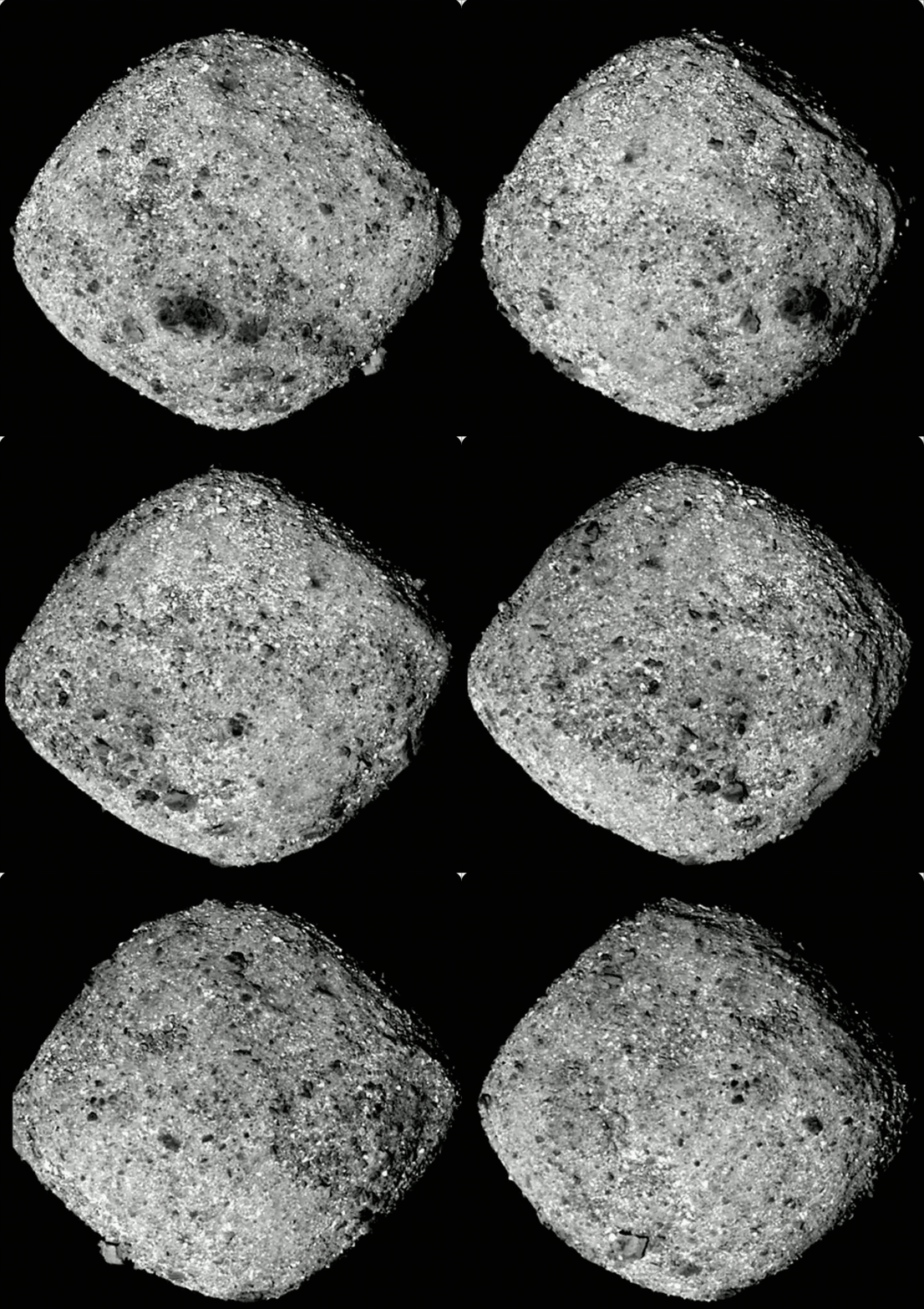
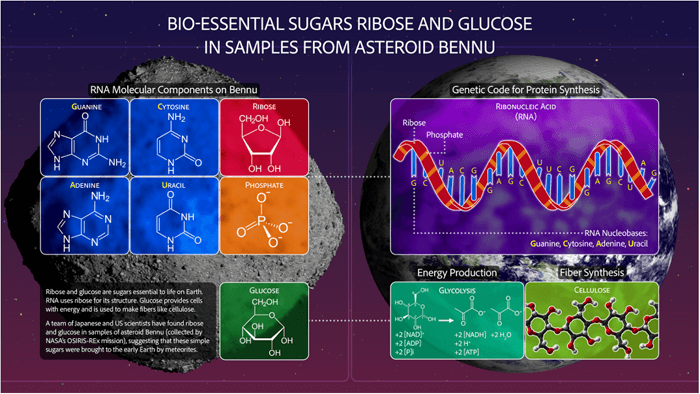
It was a beautiful September day in 2023… | | At the U.S. Department of Defense's Utah Test and Training Range, about 60 miles southwest of Salt Lake City, a spacecraft carrying extraterrestrial cargo returned to Earth. | | | | Sample Return Capsule from OSIRIS-REx | Source: NASA | | This historic event didn't get much press, but it should have. The extraterrestrial contents, we have now learned, have profound implications for our understanding of extraterrestrial life. | | Not only in our own solar system, but in our whole galaxy… and for that matter, in the immense universe that we find ourselves in. | | Asteroid Bennu | | The Origins Spectral Interpretation Resource Identification and Security – Regolith Explorer (OSIRIS-REx) has been one of NASA's most ambitious exploration missions. | | The OSIRIS-REx spacecraft was launched on September 8, 2016. Its mission was to travel to near-Earth asteroid Bennu (FKA 1999 RQ36) to collect a sample of rocks and dust from the asteroid's surface. | | The mission was spectacular. For 505 days, the OSIRIS-REx spacecraft achieved and maintained the closest orbit of any celestial body, just 1.75 kilometers from the surface. This enabled highly detailed mapping and imagery of Bennu. | | | | Source: NASA | | Bennu was an interesting target for NASA. The asteroid was formed about 4.6 billion years ago. Scientists, having used remote sensing to analyze it, believed it to be carbon-rich and abundant with organic compounds. | | Bennu is unique in that every six years or so, it comes within about 300,000 kilometers – that's about 186,400 miles – from Earth. | | That's a relatively short distance in the context of the massive size of our own solar system. After all, Earth is, at a minimum, about 55 million kilometers from Mars, and as far as 400 million kilometers. Bennu's proximity in comparison to other celestial bodies made it a favorable target for this mission. | | OSIRIS-REx – after successfully traveling to, orbiting, and collecting 121.6 grams of samples from Bennu – returned to Earth and dropped the sample return capsule shown earlier into Earth's atmosphere for analysis. The capsule descended by parachute to Utah within about a mile of its intended target. | | While the capsule returned in 2023, that was just the beginning of the research and analysis of the extraterrestrial samples. | | The materials were pristine and sealed within the sample return capsule, providing astrobiologists and chemists an extremely rare opportunity to come in contact with primordial building blocks of life, or so they hoped. | | The Building Blocks of Life | We found out earlier this week just how remarkable the samples from Bennu were. A combined team from NASA and Japan published their findings in Nature Geoscience. | | This team had previous experience working with a very small 5-gram sample from asteroid Ryugu from Japan's Hayabusa2 mission, which revealed some definitive evidence of extraterrestrial life potentially within our own solar system, and definitely beyond. | | But as for the Bennu samples… it was an absolute jackpot. | | NASA announced the discovery of five-carbon sugar ribose and six-carbon glucose in the materials collected there. Ribose (RNA sugar) combined with phosphate is the backbone for ribonucleic acid (RNA). And glucose is the source of energy for life. | | | | Source: NASA | | Ribose and glucose were the two missing elements for life from the previous analysis of the Bennu samples. In previous research, the scientists had already found four key nucleobases, namely guanine, cytosine, adenine, uracil, as well as phosphate. This latest discovery added ribose and glucose. | | The significance of this is remarkable. | | Bennu, a single small near-Earth asteroid, has all five nucleobases that are needed to construct DNA and RNA, combined with phosphate AND an energy source – glucose. The presence of ribose also suggests that the first forms of life most likely relied upon RNA as the primary molecule in the evolution of life. | | As Furukawa, one of the scientists, explained… | | | RNA is the leading candidate for the first functional biopolymer because it can store genetic information and catalyze many biological reactions. | | | | In addition to the ribose and glucose, a "space gum" was also discovered. It is a polymer-like material that is rich in nitrogen and oxygen, which could be instrumental in triggering life on any life-sustaining planet or moon. | | The significance of these findings should be obvious… | | | | Life Beyond Earth | | As Bennu was formed at the time that our solar system was being formed, these findings make it clear that the building blocks required for life were, and still are, abundant… not only in our solar system, but in our galaxy and beyond. | | One of NASA's astrobiologists summed up the discovery well… | | | I'm becoming much more optimistic that we may be able to find life beyond Earth, even in our own solar system. | | | | From my perspective, it is a near certainty in our solar system. The most likely locations are: | - Jupiter's moon Europa. It contains a subsurface ocean with more liquid water than all of Earth's oceans. There are also likely hydrothermal vents similar to Earth's on Europa, increasing the chances for some forms of life.
- Saturn's moon Enceladus, which we already know has geysers that erupt with water vapor. Past flybys of the Cassini spacecraft have already detected hydrogen gas and complex organic molecules that could indicate the possibility of life forms.
- Saturn's other moon, Titan, could perhaps be the most interesting location. Its nitrogen-rich atmosphere and liquid methane lakes could result in different kinds of life forms that use hydrocarbons instead of water for life.
| | But outside of our solar system, in the Milky Way galaxy alone, the possibilities number in the billions of potential planets and moons that could harbor life. | | There are hundreds of billions of stars in the Milky Way galaxy, with many of them home to planetary systems. If we are to look for just stars similar to our own Sun and habitable zones similar to where the Earth sits in our own solar system, there are at least 300 million potentially habitable exoplanets. | | | | But if we expand our criteria to other stars and moons, we get into the billions of possible locations for life. | | Going the Distance | | With the recent discovery from the Bennu samples, the building blocks for life are abundant throughout the Milky Way and beyond. | | I feel confident saying that life is abundant throughout our own galaxy, but unfortunately, the distances are so vast that in the absence of a breakthrough in propulsion, we won't make those discoveries in our lifetimes. | | But it is likely that we make those discoveries within our own solar system in that timeframe. | | OSIRIS-REx brought back an incredible life-changing discovery when it returned to Earth, and, incredibly, its job isn't finished. | | When OSIRIS-REx returned to Earth, it simply dropped off the return capsule as it sped past our planet on the way to its next destination. | | The spacecraft was renamed to OSIRIS-APEX for its next mission to explore asteroid Apophis in 2029. | | This has been such an exciting exploration mission to follow over the years, and one that is quite personal as I've been tracking the progress of this mission since the beginning at Brownstone Research, which I founded in the summer of 2015. | | And it has produced an incredible scientific discovery with profound implications to some of the biggest unanswered questions in life, like – are we alone? | | We are not… | | And we have so much to look forward to, | | Jeff | | | | | | | In computer science, a full-fledged optical computer is an unsolved grand challenge… | | | | | | Google has boldly announced "A New Era of Intelligence" with the latest release of its frontier AI model –... | | | | | | Tomorrow marks seven years since Google's artificial intelligence from its DeepMind division – AlphaFold – shocked the entire life... | | | | | | | | | | | | | | | To ensure our emails continue reaching your inbox, please add our email address to your address book. This editorial email containing advertisements was sent to ahmedwithnour@gmail.com because you subscribed to this service. To stop receiving these emails, click here. Brownstone Research welcomes your feedback and questions. But please note: The law prohibits us from giving personalized advice. To contact Customer Service, call toll free Domestic/International: 1-888-493-3156, Mon-Fri, 9am-5pm ET, or email us here. © 2025 Brownstone Research. All rights reserved. Any reproduction, copying, or redistribution of our content, in whole or in part, is prohibited without written permission from Brownstone Research. | | | | |








0 التعليقات:
إرسال تعليق