| |
| Structured Chaos & The Future of Compute |
| By Jeff Brown, Editor, The Bleeding Edge |
| |
It was a grand challenge to life sciences: Understanding the structure of how the world's universe of proteins folds. |
| |
| In the same way, for computer science, a full-fledged optical computer is an unsolved grand challenge. |
| The crux of the challenge has come down to a materials science problem… |
| Today's fields of photonics and optical interconnects largely use waveguides and filters to control the light, namely blocking out most of any unwanted electromagnetic waves that can interfere with or cause degradation to the optical signal. |
| This has been a sector of high tech that I've covered extensively in my flagship backend research service, Exponential Tech Investor, with great investment success. |
| Favorites of mine have been Infinera (INFN) (recently acquired by Nokia (NOK)), Lumentum (LITE), Coherent (COHR), and MACOM (MTSI). |
| Naturally, some of the big players are also involved, like Cisco (CSCO), Intel (INTC), Broadcom (AVGO), and Marvell (MRVL) – which we'll get to in a moment. |
| The industry's interest in "light" – photonics-based solutions – is simple. |
| In the context of fiber optic cables and optical interconnects, photons travel much faster than electrical signals – roughly about 68% of the speed of light. Electrical signals are like a tortoise competing against a hare in a race. |
| And in the case of photonics-based integrated circuits, the primary driver is dramatically improving energy efficiency over traditional silicon-based semiconductor designs. |
| Photonics have been in use in computing and IT infrastructure for decades… |
| But we hit an inflection point in the last couple of years, caused by the now well-known fact that energy production is the ultimate bottleneck to building out AI infrastructure. |
| Simply put: Wherever energy efficiency can be improved, it must be improved. |
| That's why a full-fledged optical computer represents such a fascinating future technology. |
| Not only will an optical computer demonstrate radically improved energy efficiency per unit of compute, but it will also be lightning fast… with incredible performance improvements compared to today's computing systems. |
| And last month, thanks to some researchers at New York University (NYU), the industry may have a path forward to accomplishing just that. |
| |
| Gyromorphic Materials |
| The NYU researchers discovered a new material – gyromorphs – that combines properties of liquids and crystals that exhibit isotropic bandgap properties. |
| Isotropic bandgap materials are critically important in photonics because they are effective at blocking light coming in from all angles. |
| A material capable of doing that can reduce or eliminate any interference or noise in a photonic system. |
| Theoretically, gyromorphs could be the key to unlocking the development of an optical computer. |
| |
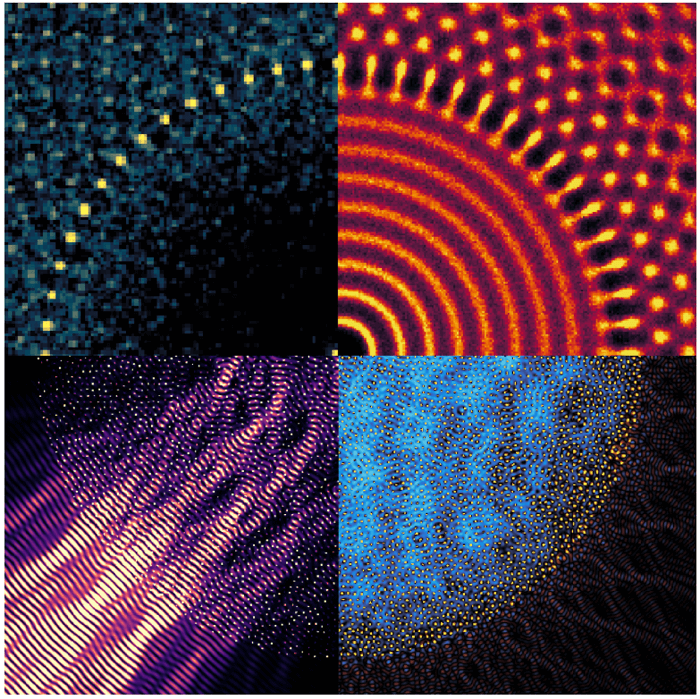
| Properties of a 60-fold Gyromorph | Source: New York University |
| Shown above are the properties of the gyromorph, discovered by the team at NYU: |
- Upper left (structure) – structure factor
- Upper right (structure) – pair correlation function
- Lower left (optical) – polarized light beam fully reflected by a gyromorph
- Lower right (optical) – density of states depletion in the gyromorph
|
| The gyromorph exhibits properties that are better than anything else known today for blocking out any unwanted light. |
| The gyromorph's structure is unique in that it exhibits properties of both liquids and crystals… and appears random yet still has structure. |
| It's a tough concept to grok, but the researchers used a helpful analogy of trees in a forest to explain it… |
| Naturally, trees grow randomly in a forest. They aren't planted in rows – the seeds find soil through wind and birds, take root, and grow. |
| And yet, a forest has a natural rhythm. Trees tend to grow certain distances from one another. The ones that can't get enough sunlight struggle to make it. A forest tends to find a natural equilibrium in its spacing. |
| I like the analogy. The unique, random-yet-structured design of a gyromorph is precisely what makes it so effective in blocking out light waves coming from any direction. Like a dense tree canopy. |
| This research is already getting a lot of attention. |
| As I mentioned, there is an urgency in the industry to adopt photonics wherever possible in computing systems, because of energy efficiency. |
| So it came as no surprise to see semiconductor company Marvell make a big move in this direction… |
| Accelerating Next-Gen Data Centers |
Marvell announced yesterday its acquisition of private tech company Celestial AI for a minimum of $3.25 billion in cash and stock. |
| The final price could be as high as $5.5 billion if Celestial AI hits its revenue milestones agreed to in the deal. |
| |
| Source: Marvell |
| This is a smart acquisition by Marvell (MRVL), a favorite company of mine that has been in our model portfolio of The Near Future Report, delivering great returns . |
| Celestial AI has been well-known as a next-generation optical interconnect company. |
| Its technology helps to connect high-performance computing systems, which enable the coherent operation of all the servers in these massive AI data centers. They are critical to improving the overall performance of these AI factories. |
| Celestial's path to acquisition as a hardware company also represents something extraordinary. |
| Having only been founded in 2020, Celestial grew to a $2.5 billion valuation by March of this year after a $250 million venture capital raise. And its trajectory culminated in the $3.25 billion acquisition by Marvell… all in less than five years. |
| This is something that we'd typically see in a hot software company, not a deep tech hardware company. That makes this deal, and what's happening in the industry, so exciting. |
| Marvell's acquisition of Celestial AI is also a sign of things to come. Hardware is back in fashion now in Silicon Valley. I haven't seen this level of investment in this sector for decades. |
| Interest levels for companies trying to develop the next generation of computing technology are getting the most interest these days. There is a clear understanding that it's time for a radical shift in architecture. |
| While there are too many early-stage, small, private companies working on these challenges to mention, there are two more advanced, notable private tech companies building in this space that I am particularly excited about: |
- Ayar Labs – which makes optical I/O chiplets and interconnects for AI
- Lightmatter – which makes photonic processors and interconnects for AI.
|
| Both companies have $1 billion-plus valuations and have the potential for an IPO or acquisition. |
| Regardless, Marvell's acquisition of Celestial AI – combined with the research out of NYU – will only act as a catalyst for even more investment in optical computing technology. |
| More breakthroughs will follow. |
| Can you see the light? |
| Jeff |
| P.S. In case you haven't heard, our colleagues over at The Opportunistic Trader are unveiling an exciting opportunity this evening at 8 p.m. ET… |
| Larry Benedict is calling it his most exciting venture since his days managing his hedge fund, where he went on a two-decade winning streak… |
| He calls it "Benedict Capital," and he says it could help you create an entire nest egg with the added benefit of letting you take charge. You make the trades, you keep all the profits. |
| Granted, this is a pretty ambitious venture, and it won't be for everyone… but it does offer hedge fund-like potential to everyday investors who wouldn't normally have access to that kind of wealth. |
| |
| |






0 التعليقات:
إرسال تعليق