| |
It's been the single most exponential trend all year… |
| And it's been easy to miss. |
| With all the bells and whistles we've been reading about in The Bleeding Edge – highlighting all the incredible breakthroughs that have been happening as a result of this semiconductor-enabled, intelligent-reasoning software that has taken the world by storm… |
| This one will take the cake. |
| Seeing it is believing it. |
| So that's exactly what we'll do today. We'll show you. |
| It is the most powerful trend that allows us to understand why AI adoption has been so quick, why the business models are sound, and why the explosion in productivity and GDP growth will be unlike anything in history. |
| We haven't seen anything yet. |
| I'm referring, of course, to the exponential decline in the cost of "intelligence." |
| Intelligence-to-Price Ratio |
| Conceptually, it might be a bit tricky to understand… |
| So here's a simple way to think about it: "cost of intelligence per unit of compute." |
| Another way to think about it is that per unit of intelligence (a stated AI output), the costs are declining exponentially. It's costing less and less to arrive at the same AI output. |
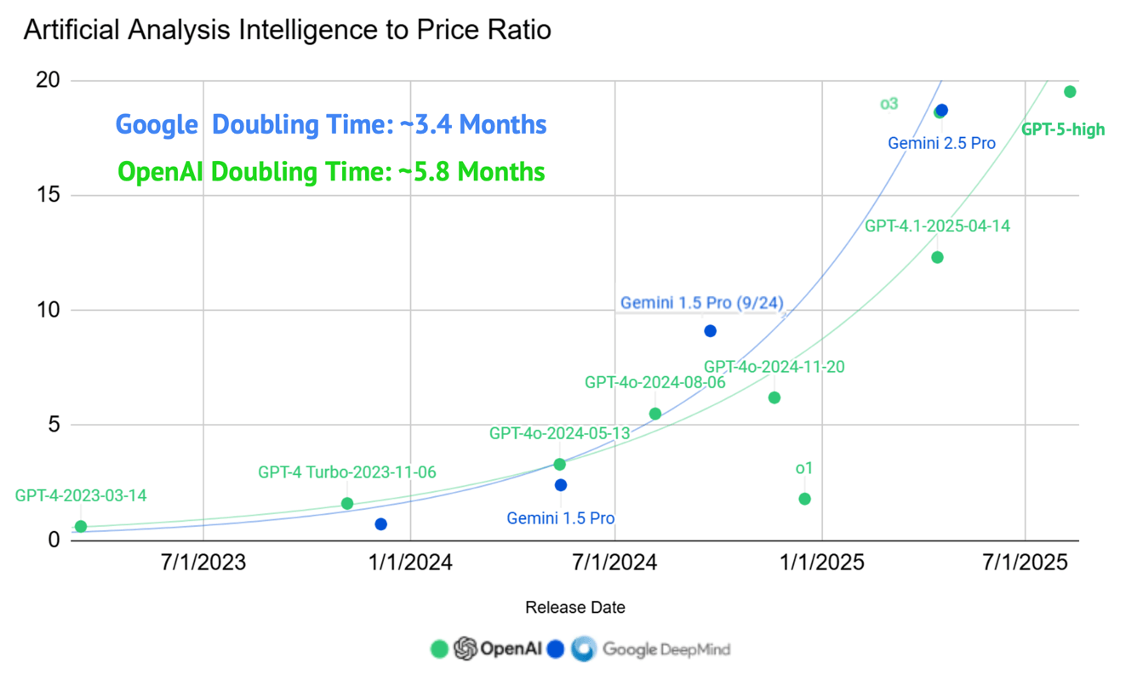
| Shown below is an example of the "Intelligence-to-Price Ratio" of two prominent frontier AI models, OpenAI's GPT and Google DeepMind's Gemini. |
| |
| Source: Air Street Capital |
| The chart above is useful because we can see the inflection point in late 2024, where the curves start to go exponential. |
| "Intelligence-to-Price Ratio" is just another way of saying that the cost of running frontier AI models is declining exponentially per unit of intelligence. |
| To oversimplify, it is getting much, much cheaper to run AI applications. |
| The chart above demonstrates that OpenAI's "doubling time" is down to 5.8 months, and Google's doubling time is down to 3.4 months. |
| For reference, Moore's Law is predicated on a doubling time of 18–24 months. |
| Just 3.4 months is mind-blowing. |
| And the above data is through July of this year. It's now December… |
| By the above metrics, OpenAI's cost per unit of intelligence has already fallen by half again, and Google's cost has almost fallen by half twice (two halvings). |
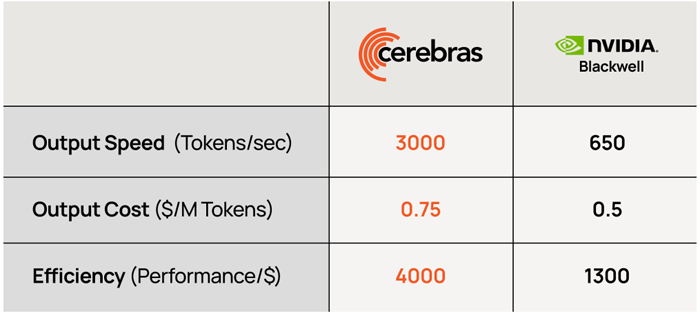
| To put things in perspective, the cost of the output of a million tokens from an AI model has dropped below $1. |
| A token can be a short word, a part of a long word, or punctuation. |
| A simple way to think of the relationship between tokens and words is for every 100 tokens, it equates to about 75 words. |
| |
| Source: Cerebras |
| So for just 50 cents, we can get 750,000 words of output from an AI model. That's how cheap running AI software has already become. |
| How is this possible? |
| A Precipitous Fall |
| There is some nuance here we must understand, because cost is absolutely dependent on which semiconductors are being used for inference, and which AI models are being run. |
| With every successive release of bleeding-edge semiconductor technology – and with every new frontier AI model – they become more efficient per unit of compute. Which is to say, the cost per unit of performance continues to decline exponentially. |
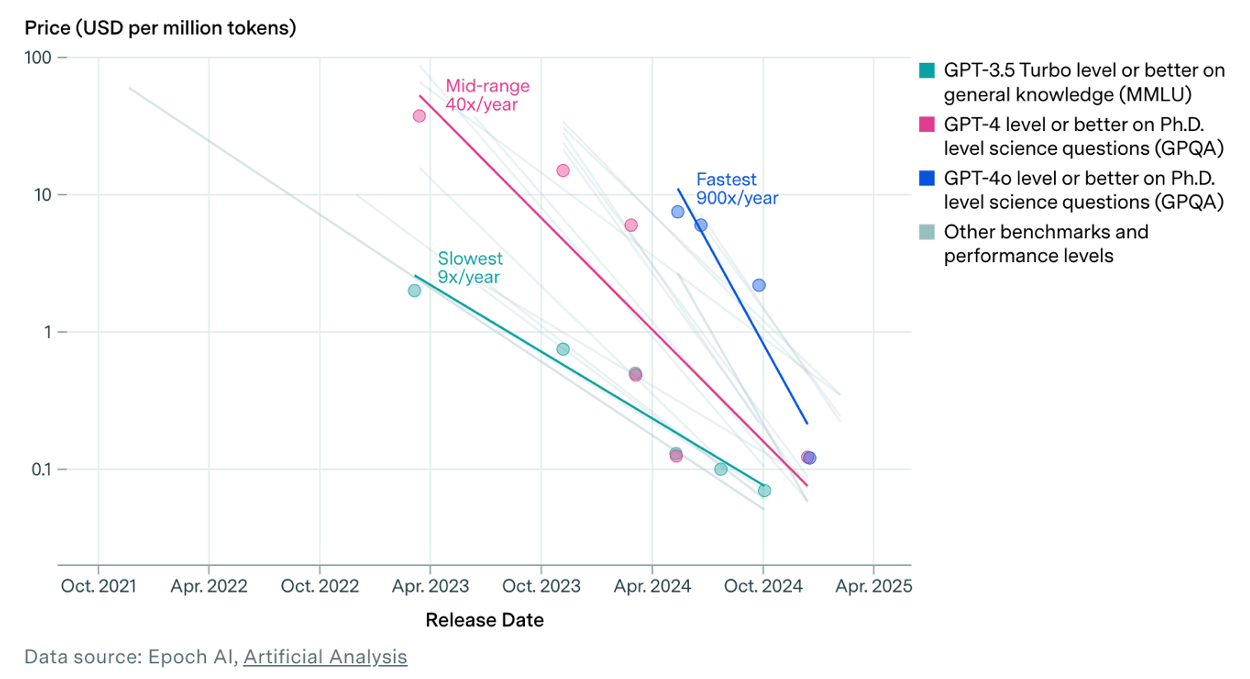
| The chart below is even more dramatic, demonstrating the difference between an "older" frontier model like GPT-3.5 (in green) declining in cost by 9X a year, and the more advanced GPT-4o model declining at a precipitous 900X a year. |
| |
| A 900X decline a year in the cost of outputting 1 million tokens (~750,000 words). |
| Months from now, that cost will become pennies. Affordable for anyone. |
| That's why the Jevons Paradox is being discussed so widely in the industry now. |
| Recommended Links
America's Economic "Big Bang"
Five Years of Economic Growth in the Next 12 Months After predicting the rise of AI, quantum computing, genetic editing, and more… Jeff Brown believes America is going to experience an economic "big bang" in 2026. This has only happened a few times in history… - One "big bang" created America's first millionaires
- Another triggered a four-decade bull market
- And yet another sent individual stocks soaring 1,000%+.
But now, what's coming could be an order of magnitude bigger… And it's all set to begin in the coming weeks. Join Jeff tonight, December 18, at 8 p.m. ET for the details – attendees will get one of his top picks to buy now, completely free. Register with one click here >>>
(When you click the link, your email address will automatically be added to Jeff's guest list)
The Next Big Moment for the New Micro Mag 7! The "Next Magnificent 7" dominated the S&P 500 by 450% in 2025. But now, thanks to an unprecedented AI spending binge by America and China, the New Micro Mag 7 could be the hottest stocks in 2026. Reserve Your spot for the AI Supremacy Summit on December 22 at 1 p.m. ET.
| |
| Jevons Paradox in Hyperdrive |
| The principle is simple: As efficiency improves, it drives down costs. And as costs decline, consumption increases. |
| There has never been a more appropriate example of this than with what is happening with artificial intelligence. |
| This is the Jevons Paradox in hyperdrive. |
| At a 900X decline per year, we're at warp speed right now. |
| And personalized agentic AI capabilities that will become widely available next year are the "agents" that will accelerate adoption beyond light speed. |
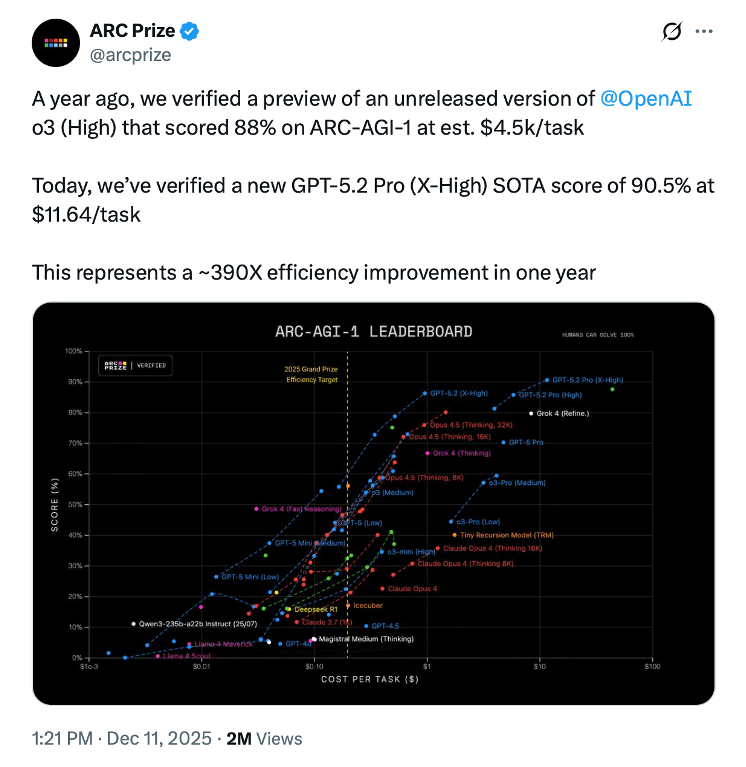
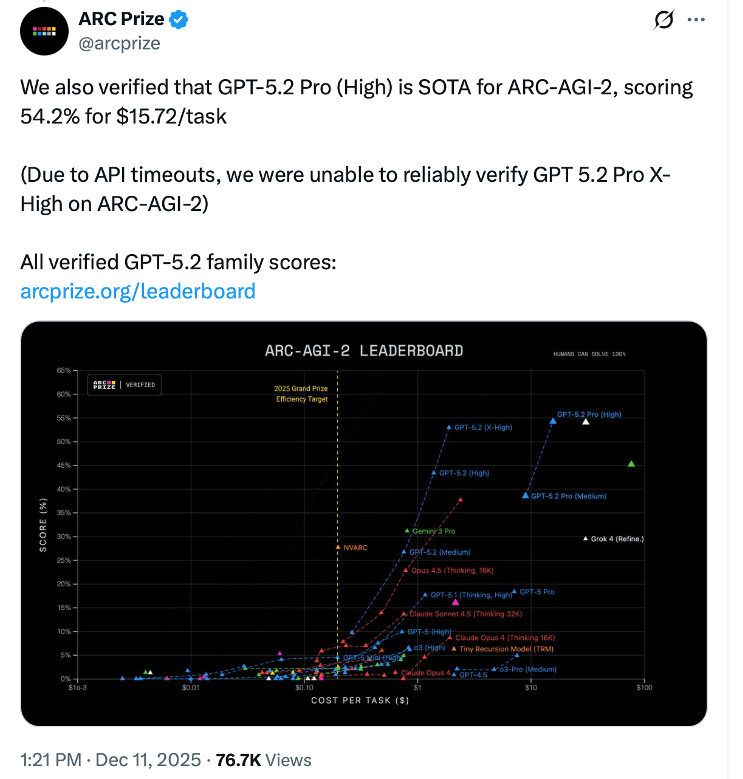
| I've been thinking a lot about this acceleration in the last few months. And I was reminded of this a few days ago, when the ARC Prize organization provided an end-of-year update on its ARC-AGI leaderboards. |
| |
| Source: ARC Prize |
| The latest release from OpenAI with its GPT-5.2 is impressive. |
| |
| The leaderboard will be different by January, but that's not the key point… |
| Bending Backwards |
| What is relevant is that the latest leaderboard has shown the dramatic difference in cost per task of the ARC-AGI-1 test for artificial general intelligence (AGI). |
| That cost has declined from $4,500 per task to just $11.64 per task, now scoring 90.5% on the ARC-AGI-1 test. That represents a 390X improvement in efficiency. In a single year. |
| Almost unbelievable… |
| The same is true for the ARC-AGI-2 test, which is much harder than the original ARC-AGI-1 test. |
| GPT-5.2 is now the first to achieve more than 50% on the test, overtaking Gemini 3 Pro and Grok 4 at just $15.72 per task. |
| |
| What's incredible is that in 2026, the above chart is going to bend back on itself. |
| It will curve to the left, as the cost per task declines to less than $0.50 and the score nears 100%. |
| ARC Prize set a Grand Prize challenge to achieve $0.20 per task this year. |
| That was very aggressive, and it didn't happen this year, but with another 390X improvement in efficiency in 2026, it will happen next year. |
| What comes next? |
| The team at ARC Prize will release a devious ARC-AGI-3 challenge. This will require advanced reasoning for an AI, which will be required to demonstrate the ability to learn and generalize in novel environments. |
| And it all must be done efficiently (i.e., cheaply). |
| What's after that? |
| AGI. And it's months away. |
| And despite the trillions of dollars being spent to build AI data centers in this once-in-a-lifetime race, this technology will be dirt cheap to run. And it will be available to everyone on the planet who has access to the internet. |
| It will be the most rapid adoption of technology in history. |
| It will be unlike anything we've ever experienced before. |
| Get ready for a wild year. |
| Jeff |
| |











0 التعليقات:
إرسال تعليق