Trump Moves to Restrict Institutional Home Buying — What It Means for the Market |
|
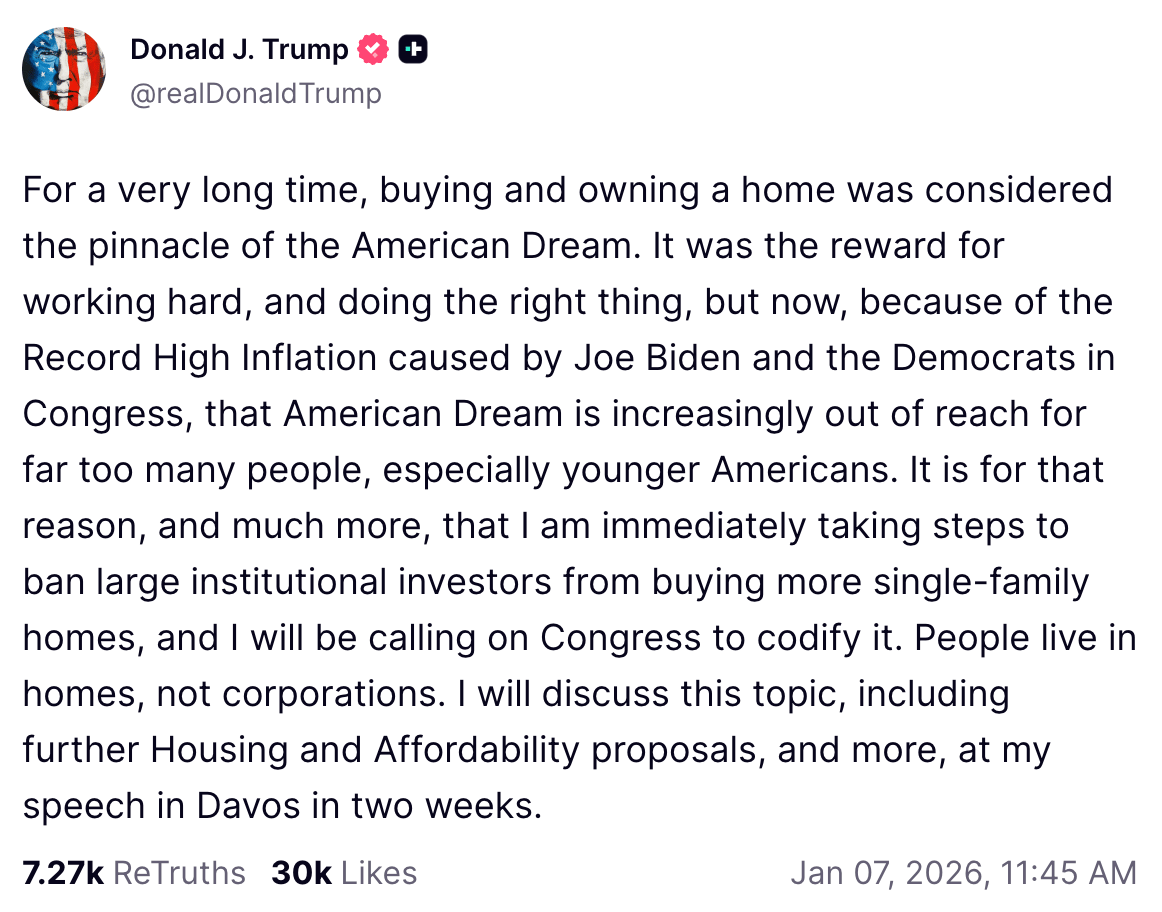
President Trump used his social platform today to announce an ambitious plan: ban large institutional investors from purchasing single-family homes in the United States. |
He framed the move as a way to make housing more accessible for everyday Americans, arguing that "people live in homes, not corporations." |
This proposal has already reverberated through markets and the housing sector, and today we break down what it could mean for homeowners, investors, and large asset managers. |
What Trump Is Proposing |
Trump's announcement would direct the administration — and ask Congress — to block large private-equity firms and institutional investors from buying single-family homes going forward. He tied the proposal to concerns about affordability and stressed that homes should be in the hands of individuals and families rather than corporations. |
This comes as homeownership has become increasingly difficult for many Americans, especially younger buyers facing high prices, elevated mortgage rates, and limited inventory. |
Immediate Market Reaction |
Real estate markets and related stocks reacted quickly to the announcement: |
Shares of major single-family rental companies like Invitation Homes and American Homes 4 Rent fell sharply, marking some of the biggest declines in years. Broader investor sentiment toward real estate and landlord names was shaken, with some financial stocks and ETFs tied to property markets also weakening.
|
This suggests markets are already pricing in the potential risk of reduced institutional buying power and a possible shift in housing demand dynamics. |
How This Could Impact the Broader Housing Market |
1. Supply and Pricing Dynamics |
Proponents of the ban argue that removing large investors from the buying pool would free up inventory for smaller buyers and potentially slow price growth or even ease affordability in some markets. Trump and supporters believe this could allow more families to compete without being outbid by deep-pocketed institutional buyers. |
However, evidence about the scale of institutional ownership is nuanced. Large investors collectively own a small fraction of single-family homes nationwide — estimated to be less than 1–2% — though their share can be higher in certain metro areas like Atlanta, where up to 30% of single-family rentals are owned by corporate entities. |
2. Rental Market and Investors |
If large buyers are restricted, smaller investors and regional landlords may see greater opportunity in rental markets, potentially stabilizing or expanding their role. Meanwhile, price momentum in certain markets may adjust as investor demand shifts or cools. |
What This Means for Big Asset Managers |
Private equity and real estate firms such as Blackstone, Invitation Homes, and American Homes 4 Rent were among the hardest hit in market response. These firms have been active in the single-family rental segment over the past decade, and a regulatory ban would impact their growth strategies and valuations. |
There's been public confusion about the role of some asset managers in the homebuying market. Importantly, BlackRock has stated that it does not buy individual single-family homes as an institution, though it is active in financing and investing in broader real estate markets and mortgage instruments. |
Despite this distinction, broad policy proposals restricting institutional purchases — even if targeted at other firms — can cool sentiment across real estate investment trusts (REITs), asset managers, and related financial vehicles that are exposed to housing or rental markets. |
Political and Policy Context |
Restrictions on institutional homebuyers have cropped up in policy discussions before, with past legislative proposals aimed at curbing hedge fund ownership of homes to protect affordability. |
Magnetizing this debate now, the housing crisis — driven by supply shortages, long mortgage timelines, and demographic shifts — continues to be a potent political theme, especially with elections approaching and affordability front of mind for many voters. |
What to Watch Next |
Congressional action and legal framework: Trump's plan would need legislative backing to become enforceable. Housing inventory trends: Will restricting large buyers change the flow of listings? REIT and property sector valuations: Continued sector weakness or rotation could signal investor skepticism. Regional market effects: Metro areas with higher institutional ownership may see more pronounced impacts.
|
Bottom Line |
Trump's proposal is a bold policy shift aimed at rebalancing the housing market toward individual ownership. While its effectiveness and feasibility are still uncertain, the announcement has already influenced market sentiment — from real estate equities to broader housing discussions. |
As with all major policy moves, the real economic impact will depend on how the measures are written, implemented, and received by markets and homeowners alike. |
-America First, America Always |
|
Forget NVIDIA. Forget Tesla. Forget Bitcoin. The real story isn't any of them.
It's a tiny, obscure company most Americans have never heard of.
From the outside, it's just another boring chipmaker.
But behind closed doors, this company controls nearly 7,000 patents so powerful, the U.S. government called them "vital to national security."
Patents NVIDIA, Apple, Google, and Amazon must all license.
Go here now to see Dylan's confidential report before this stock hits the front page. |
|




0 التعليقات:
إرسال تعليق