| |
The latest releases of agentic AI software have given the software industry a sense of amazement, excitement, and sadness. |
| The amazement and excitement are driven by the remarkable capabilities of the intelligent software, which is now capable of performing complex tasks in seconds – some so complex, they're nearly impossible for humans. |
| The sadness comes from a sense of remorse, or perhaps grief, at having spent years, or decades, developing software programming skills… only to then witness an agentic AI coding agent perform those same skills without breaking a single drop of sweat. |
| And in a fraction of the time, and for a fraction of the cost. |
| It's not a productive use of time to lament over these incredible advances in technology. It only makes sense to lean in, leverage the tech, and benefit from the productivity-altering intelligence. |
| This latest breakthrough felt like it came out of nowhere. |
| The Rapid Shortening of Doubling Time |
| |
| Not only are "they" communicating amongst each other, but they are also doing what the title suggests – interacting and transacting in the real world, both online and through human proxies. |
| The inflection point for these latest agentic developments was the release of Anthropic's Claude Opus 4.5 in late November and OpenAI's GPT 5.2 in early December. |
| These latest frontier AI model releases have since fueled the advances that have taken the industry by surprise. |
| And now, they've turned to agentic software programming. |
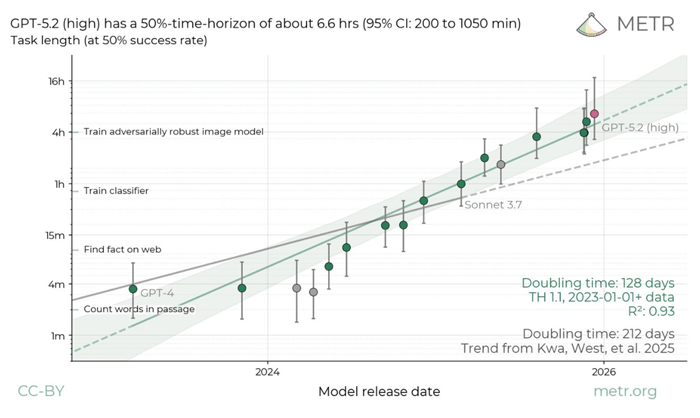
| One way that we can visually understand the significance of what's happening is to understand how long an agentic AI can perform software programming tasks (i.e., an agentic AI's time horizon). |
| Below is a logarithmic chart that shows – in early 2024 – the time horizon for an agentic AI with a 50% success rate. |
| The result in 2024 was just shy of four minutes. |
| Today, best-in-class is now 6.6 hours. |
| |
| Source: METR |
| The rate of progress is extraordinary, and it's difficult to contextualize. |
| It's also accelerating… |
| The doubling time is shortening, now down to around every four months. And that timeframe will continue to shrink as we look ahead. |
| Logarithmic charts can be difficult to intuitively understand. In the chart above, the y-axis, which is time, increases each unit of time by roughly 4X. |
| One minute to four minutes, four minutes to 15 minutes, 15 minutes to one hour, etc. |
| This kind of exponential growth is difficult to show on a linear graph. The graph would become too large. |
| So let's look at another. |
| The Definition of Exponential |
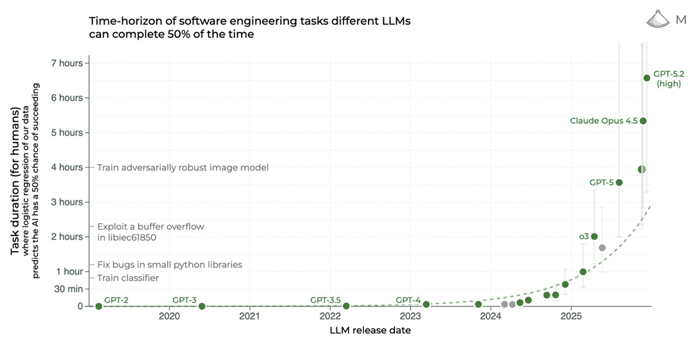
| Below is a simpler linear graph that visually represents the inflection point. |
| This time, it shows the time horizon for an agentic AI to complete human tasks, as measured in hours of work. |
| |
| Source: METR |
| The key point for us to understand is that the latest releases of Claude Opus 4.5 and GPT 5.2 have hit the part of an exponential curve that basically goes vertical. |
| We can see the last three dots on the chart basically stacked on top of one another. |
| The effect of this has been palpable in the 30–45 days among the software developer community. |
| All the excitement is coming from the ability of these agentic AI models to be able to "read" your software code base as well as understand all the software on your computer. |
| And once it understands all the software and data on your computer, it can plan a multi-step process to accomplish the work you need done. |
| And then it can autonomously execute that plan. |
| Recommended Links
He Made $10 Million From a Single Phone Call Every quarter, CEOs of America’s biggest companies are legally required to get on the phone and tell the truth about their businesses. Anyone can listen in. Almost nobody knows what to listen for. Larry Benedict does. He used these calls to go 20 years without a single losing year at his top 1% hedge fund. His followers could have collected payouts of $7,000…$9,400… and even $12,750 from what he’s heard. On Wednesday, February 11 at 8 p.m. ET, he’s revealing his eight "money call" signals for the first time – plus a potential "255%" opportunity he’s tracking right now. Register with a single click here.
(When you click the link, your email address will be added to the event guest list.)
What's Really Going On Inside AI Data Centers? The lightning rod for AI bubble fears is the AI data center. These humongous buildings are popping up all over America. They cost hundreds of millions, even billions of dollars each. Just one data center uses as much energy as a small city. But what is all of this leading to? Do we even need all of these data centers? Click here to learn the disturbing truth.
| |
| RIP Coding by Hand |
This is why there has been so much excitement around OpenClaw, the open-source agentic AI built upon Claude Code, which is based on Claude Opus 4.5. |
| As a reminder, OpenClaw itself was programmed entirely by AI. |
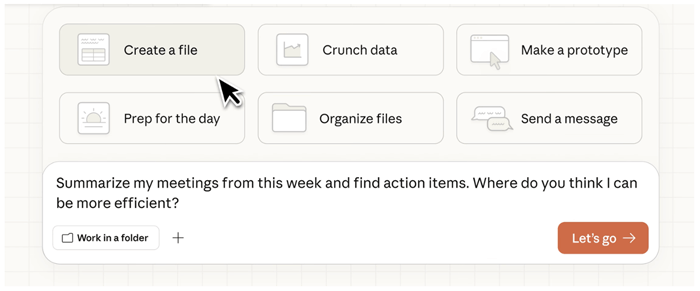
| As if this weren't enough, Anthropic launched Claude Cowork on January 12, which is designed for much more than software programming. |
| Download the software to your computer… allow it access to your files, data, and software… and put it to work with a simple prompt. |
| |
| Source: Anthropic |
| It's so simple and powerful that anyone can use it. No programming skills required at all. |
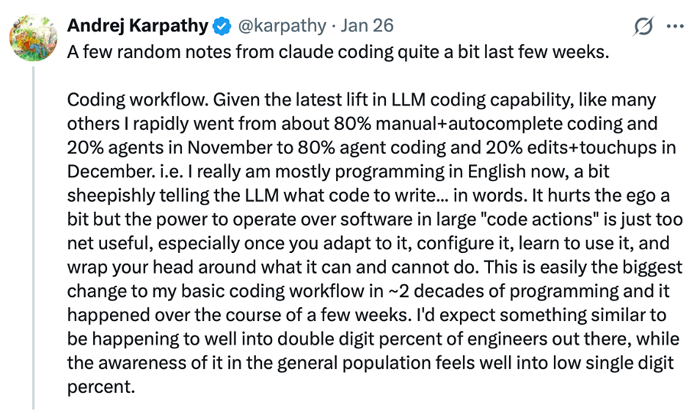
| The significance of this moment is summed up well by Andrej Karpathy, formerly the Director of AI at Tesla and also a founder of OpenAI, who has been very pessimistic on agentic capabilities and artificial general intelligence (AGI)… up until just a couple of months ago. |
| |
| Karpathy went from 80% manual coding and 20% agentic AI… to 80% agentic AI with only 20% in "edits+touchups"… in the span of just one month. |
| Karpathy and so many others are struggling to extrapolate the implications of what just happened. |
| So is Wall Street. |
| The Democratization of Programming |
| High-quality software stocks have been absolutely punished in the last year, despite having incredible financial metrics. |
| Takes Salesforce (CRM), for example. |
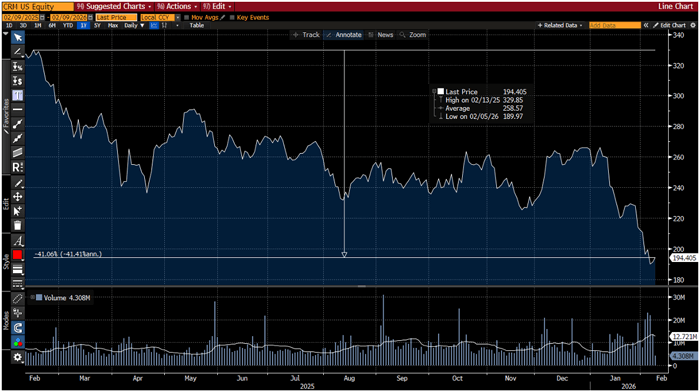
| 1-Year Chart of Salesforce (CRM) |
| |
| Salesforce has an incredible moat, fantastic pricing power, and is very sticky for companies that use its software. |
| Its software is customized for each organization, making it painful, complex, expensive, and time-consuming to switch providers. |
| And yet, in the last year, the stock has fallen more than 40% and is trading at just 3.96 times its fiscal year 2027 (ending January 31, 2027). |
| Its EV/EBITDA multiple for the same fiscal year is just 9.36. |
| Salesforce has never traded this cheaply, with the one exception of 2009 during the financial crisis. |
| This is a $182 billion company that will grow its sales at 11% this fiscal year, with nearly 81% gross margins. And it will generate $15.6 billion in free cash flow. |
| What's not to like? |
| But Wall Street can't figure out where the value will accrue in a world of agentic AI. |
| Those companies that house valuable data for a company's operations and employ agentic AI aggressively to improve their operations and utility for their customers will maintain relevance. |
| Those who lack access to vital data and only offer vertical software solutions will suffer. |
| AI companies that provide an intelligent layer of software capable of seamlessly carrying out complex tasks across multiple software platforms and computing systems will accrue value quickly. |
| The return on investment for these agentic solutions is immediate, and the agentic AI is capable of performing tasks that no human or team of humans can perform. |
| Making this shift even more remarkable is that the cost of this intelligent software is a tiny fraction of that of a human programmer. |
| The cost to use this technology per month is cheaper than the cost of a few hours of an expert human programmer. |
| We're witnessing the democratization of programming and computational tasks, and the deflationary effects on software pricing. |
| Our computing systems are going to do a whole lot more for a whole lot less. |
| And the software industry is going to have to adapt. |
| And this isn't anywhere near the endpoint… |
| xAI's Grok 4.2, which has already shown early indications of crushing leading benchmarks for agentic capabilities and even financial prediction markets, has yet to be released publicly. Its release is imminent. |
| It's showing every indication that it will be significantly more capable than GPT 5.2 or Opus 4.5. |
| And we can't forget that these powerful agentic models will quickly morph into artificial general intelligence later this year. |
| Jeff |
| |









0 التعليقات:
إرسال تعليق