I've been around the crypto block more than a few times. I've seen the To the Moon cycles and the Crypto is Dead numerous. But lately, I've been getting one question more than any other: |
| ❝ | | | "Tom, Bitcoin is sitting around $70,000, and should I just stick a miner in my spare room and let it print money?" |
|
|
It's a tempting thought. The idea of a passive income machine humming away while you sleep is the ultimate work smarter, not harder dream. But before you go out and drop five grand on an ASIC rig, we need to have a heart-to-heart about the reality of home mining in 2026. |
It's not as simple as plugging in a toaster. It's more like hosting a small, very angry jet engine that happens to pay you in satoshis. |
The Pros: Why People Still Do It |
|
1. The Satoshi Stack Without the Paper Trail |
When you buy BTC on an exchange, Uncle Sam knows exactly what you have. When you mine it, those coins go straight from the network to your wallet. For the privacy-conscious, this is the gold standard. You're earning clean BTC with no KYC (Know Your Customer) strings attached. |
2. Heating Your Home (Literally) |
In 2026, we've seen a rise in Heat-Mining. An ASIC miner is essentially a space heater that performs billions of calculations. If you live in a cold climate, using a hobbyist unit like the Canaan Avalon Nano 3 (which only pulls about 140W) to warm your home office while earning a few bucks is a genius double-dip on your utility bill. |
3. Supporting the Network |
Every home miner is a vote for decentralization. By running a node and mining at home, you're making it harder for any single entity to control the network. You aren't just an investor; you're the infrastructure. |
The Cons: The Reality Check |
|
1. The Noise (Oh, the Noise) |
Your standard pro-grade miner, like the Antminer S21, puts out about 75 decibels. To give you some perspective, that's like having a running vacuum cleaner in your room—24 hours a day. Unless you have a soundproofed garage or an immersion cooling setup, your spouse or neighbors will likely have something to say about it. |
2. The Electricity Trap |
This is where most people lose the game. In 2026, Bitcoin mining is a global arms race. If your electricity cost is above $0.10 per kWh, you're likely spending more on the power bill than you're earning in Bitcoin. |
Fact: The global average cost to mine 1 BTC currently hovers around $84,000. If your residential rates are high, you're often just buying Bitcoin at a premium through your utility company. |
3. Hardware Obsolescence |
The second a more efficient chip comes out, your machine becomes a very expensive doorstop. The 2024 halving slashed block rewards to 3.125 BTC, meaning you need top-tier efficiency just to stay in the green. |
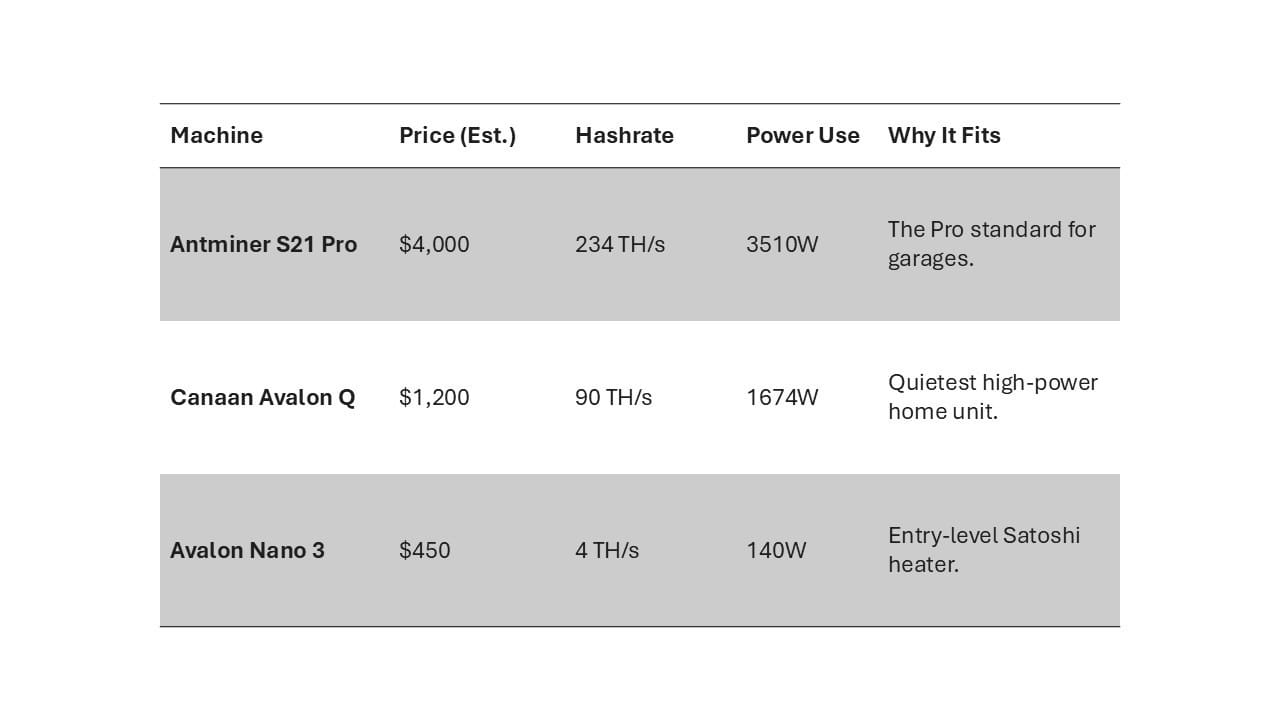
2026 Hardware ROI Comparison |
If you're serious about the numbers, here is how the top three at-home contenders stack up right now: |
|
|
|
The Verdict: Should You Do It? |
If you have free solar power, a cold basement, and a tolerance for white noise, home mining is a fantastic way to learn the guts of the financial revolution. It's a hobby that can actually pay for itself. |
But if you're doing it just for the ROI? |
Be careful. You're competing against massive farms in Ethiopia and Texas that get power for $0.04/kWh. For most people, the stress-free way to play this is to skip the hardware and just DCA (Dollar Cost Average) into the asset itself. |
The Golden Rule of 2026 |
If your electricity is cheap, mine. |
If it's not, just buy the dip. |
Helpful Resources to Get You Started: |
|
 | Best Bitcoin Miner for Immersion Liquid Cooled Bitcoin Mining |
|
|
This video is highly relevant because it explains how liquid immersion cooling can solve the noise and heat problems that typically make home mining difficult. |




0 التعليقات:
إرسال تعليق