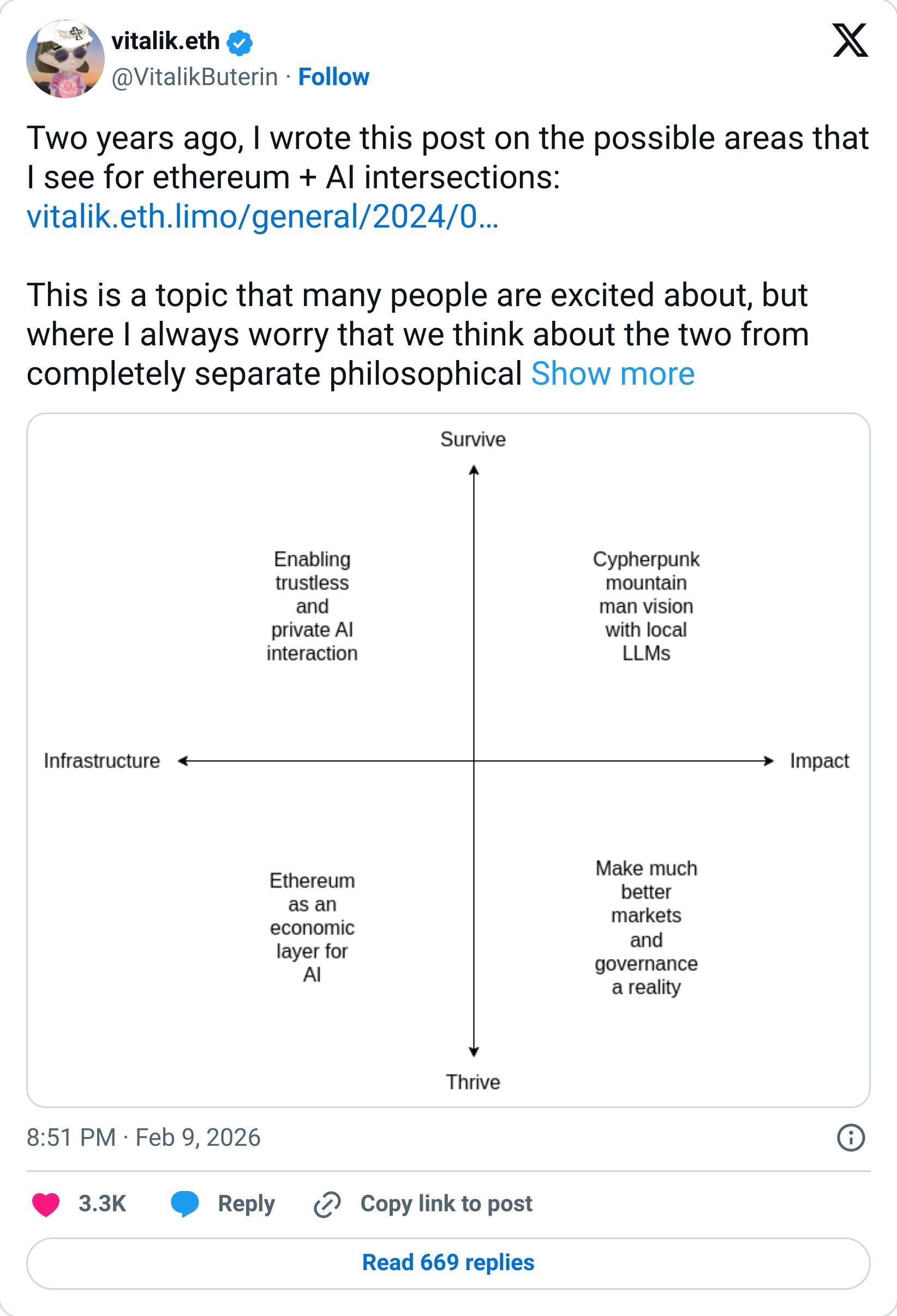
If you've been following the space for more than a cup of coffee, you know Ethereum (ETH) founder Vitalik Buterin doesn't just post. He drops architectural blueprints for the next decade, similar to Elon Musk. | Here's his latest focus… | The marriage between Ethereum and Artificial Intelligence. | To some, it sounds like tech buzzword soup. But to Vitalik, this isn't just a pivot but a necessary evolution. He's looking at 2026 as the year we reclaim computing self-sovereignty, moving away from the Big Tech silos like Google and OpenAI and toward a decentralized machine economy. | This could also help Ethereum's price, which has lagged behind recently. | The Four Pillars of the AI-Ethereum Alliance | Vitalik recently updated his framework for how these two titans collide. He isn't interested in just putting AI on the blockchain for the sake of it. He's looking at practical, defensive ways to keep AI from becoming a centralized surveillance monster. | 1. AI as a Player (The Machine Economy) - Think bots hiring other bots. AI agents don't have bank accounts, but they can have Ethereum wallets. Ethereum becomes the economic layer where AI can pay for API calls, post security deposits, and build reputations without needing a human middleman. 2. AI as the Interface (The User's Bodyguard) - Crypto is hard. Scams are everywhere. Vitalik sees AI as the shield that audits smart contracts and transaction proposals in real-time before you click confirm. 3. AI as the Rules (The Mountain Man Vision) - The old cypherpunk dream was "don't trust; verify." But who actually reads the code? Nobody. Vitalik says, "Now, we can finally make that vision happen, with LLMs doing the hard part". AI can verify everything on-chain, making the system truly trustless for the average user. 4. AI as the Objective - This is the long game—using decentralized structures (DAOs) to govern and build AI models that aren't controlled by a single corporation.
| | | Choosing a Positive Direction | One thing I love about Vitalik's take is his caution. He's not a move fast and break things guy when it comes to AGI. He recently pushed back against the acceleration at all costs mindset, stating: | | ❝ | | | To me, Ethereum... [is] precisely about choosing a positive direction rather than embracing undifferentiated acceleration of the arrow. |
|
| He's worried that if we just let AI run wild on centralized servers, we lose our privacy and our agency. By using tools like Zero-Knowledge Proofs (ZKPs) and ERC-8004 (a standard for AI agent interaction), Ethereum can provide a neutral base layer for AI to operate without leaking your data to the world. | Why 2026 Matters | As we head deeper into 2026, the tech is finally catching up to the theory. With Layer 2 scaling making transactions nearly free and ZK-tech maturing, the bottleneck is disappearing. Vitalik believes we are moving past the era where we trade decentralization for convenience. | Butterin said at a recent summit, according to Binance Square: | | ❝ | | | 2026 is the year we take back lost ground in computing self-sovereignty. |
|
| The Bottom Line | Ethereum isn't just a place for magic internet money anymore. It's becoming the infrastructure for a world where humans and AI coexist. By providing the steering wheel (governance) and the fuel (payments), Ethereum might just be the only thing keeping the AI revolution from becoming a corporate monopoly. |
|
| | Quick Poll: | RATE TODAY'S REPORTWhat'd you think of today's edition? | |
|
| | This article is for informational purposes only. It should not be considered Financial or Legal Advice. Not all information will be accurate. Consult a financial professional before making any significant financial decisions. |
|
|
|




0 التعليقات:
إرسال تعليق