First message from our friends at Stansberry Research (Sponsor) |
More lucrative than the SpaceX IPO? |
Editor's Note: Silicon Valley legend Jeff Brown is forecasting that Elon Musk's "Kardashev Project" is about to trigger the greatest wealth creation event in history. If you missed out on Tesla... Click here to see the details of what Elon has coming next or read more below. |
|
Dear Reader, |
The mainstream news can't stop talking about Elon Musk's next move... |
|
But they're missing the bigger picture. |
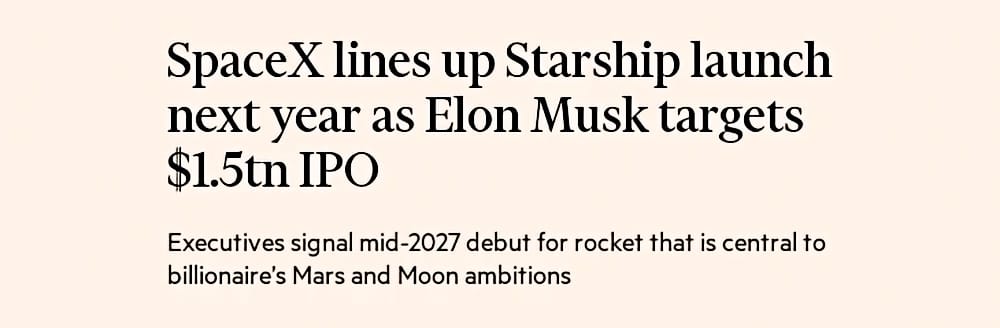
While Reuters and the Financial Times are writing about the upcoming SpaceX IPO Elon is working on something else entirely in the background. |
Something with the potential to be over 5X as valuable as the SpaceX IPO... |
And much more lucrative for investors. |
Click here to see Silicon Valley insider Jeff Brown's breakdown of what's coming on March 31, and where you can put your money today to see the potential for gains of 500%+ in the short term. |
Regards, |
Lindsey Hough
Managing Director, Brownstone Research |
|
FEATURED ARTICLE |
Ulta Beauty After the 14% Drop: Real Bargain… or a Premium Retailer Losing Its Glow? |
Ulta Beauty did not blow up. |
It did something much more annoying. |
It reported a pretty good sales quarter, reminded investors that beauty demand is still alive, and then told Wall Street that profits are likely to grow more slowly than people hoped. That is how you get a stock to fall hard without the business itself falling apart. |
On Friday, Ulta traded around $535.72, down 14.28% on the day, after opening at $566.17 and falling as low as $530.65. The company's market cap sits around $23.3 billion, and the trailing P/E has compressed to about 19.6x. |
That is a big one-day repricing for a retailer that, just one day earlier, had been riding strong momentum and trading much closer to "premium execution story" territory. Reuters said the drop was Ulta's largest decline in nearly two years, driven by margin concerns and a softer-than-hoped earnings outlook for fiscal 2026. |
And that is where the Cheap Investor question starts: |
Did Ulta just become mispriced because Wall Street overreacted to cautious guidance… or is this exactly what happens when a premium retailer runs into a margin wall? |
Scoreboard: what actually happened |
Let's begin with the numbers, because this story is much more nuanced than the price action suggests. |
Ulta's fiscal Q4 2025 results were not weak on revenue. The company reported $3.898 billion in Q4 net sales, up 11.8% year over year, and comparable sales growth of 5.8%. Full-year fiscal 2025 net sales reached $12.393 billion, up 9.7%, while full-year comparable sales rose 5.4%. Diluted EPS for the quarter was $8.01, and full-year diluted EPS was $25.64. |
So why did the stock get punished? |
Because fiscal 2026 guidance came in softer on profitability than the market wanted. Ulta guided to 6% to 7% net sales growth, 2.5% to 3.5% comparable sales growth, and diluted EPS of $28.05 to $28.55. That EPS range landed below what many analysts had been expecting, and Reuters said rising costs and margin pressure became the focal point almost immediately. |
The quarter also showed why margin concerns are real. Q4 SG&A expenses jumped to $1.003 billion, up from $815.6 million a year earlier, or 23.0% growth. As a percentage of sales, SG&A rose to 25.7% from 23.4%. Operating margin in the quarter fell to 12.2% from 14.8% a year earlier. For the full year, operating margin slipped to 12.4% from 13.9%, even though revenue grew nearly 10%. |
That is the key tension. |
The top line still looks healthy. |
The bottom line is not collapsing. |
But the cost structure is getting heavier. |
And Wall Street hates that combination when a stock is already priced like a best-in-class retailer. |
The real reason the stock fell |
This was not a "beauty is dead" reaction. |
This was a "premium multiple meets rising costs" reaction. |
Reuters reported that Ulta's operating costs rose sharply in the December quarter, driven by higher incentive compensation, increased marketing expense, and investments tied to Space NK, the British beauty retailer it acquired. Reuters also noted investor concern that Ulta's largely fixed-cost store model could make margin expansion harder if spending remains elevated. |
That matters because Ulta has historically been rewarded for executing better than general retail. It has been one of those rare specialty retailers that combined traffic, basket growth, prestige-brand relevance, and decent margin discipline. But the moment the story changes from "growth plus execution" to "growth but heavier overhead," the stock stops being a premium-quality compounder and starts being interrogated like a normal retailer. |
And normal retailers do not usually get the luxury of rich multiples. |
This is why the stock fell harder than the raw sales numbers would imply. |
The market was not only reacting to the fiscal 2026 EPS range. |
It was reacting to the possibility that Ulta's next phase may be more expensive than its last one. |
What Ulta actually is |
Ulta is not just a makeup store. |
It is the largest specialty beauty retailer in the United States, with more than 1,500 stores, spanning cosmetics, fragrance, skincare, hair care, wellness, and salon services. The business is built around a hybrid model that combines prestige beauty, mass beauty, loyalty-driven repeat traffic, services, and merchandising "newness" that keeps customers coming back. |
That mix matters because beauty has been one of the more resilient consumer categories over the past few years. Even in tougher retail environments, consumers often keep spending on beauty products, though they may adjust mix, timing, or basket size. Ulta's own fiscal 2025 performance reflects that resilience: comparable sales grew 5.4% for the year, driven by a 3.3% increase in average ticket and a 2.0% increase in transactions. In Q4 alone, average ticket rose 4.2% and transactions increased 1.6%. |
That is not what a broken consumer story looks like. |
If anything, it says the customer is still showing up. |
Which means the debate is less about demand destruction and more about how expensive it will be for Ulta to keep winning that demand. |
The new CEO angle matters more than the market is admitting |
One of the more interesting undercurrents here is that Ulta is now being evaluated under new CEO Kecia Steelman, who has been emphasizing digital outreach and younger-customer engagement, including a push on TikTok and other channels to reach Gen Z and Gen Alpha. Reuters highlighted that these strategic efforts are positive long-term, but they also require investment—and that investment is showing up in the expense line right now. |
That makes this stock more interesting than a plain vanilla "guidance miss" story. |
Because this is not just about a bad quarter. |
It is about a possible transition year. |
Ulta may be spending more aggressively now to protect its relevance in the next generation of beauty retail. If that spending works, the stock may look cheap in hindsight after this drop. If it does not, the selloff may simply be the first stage of a longer de-rating. |
That is the kind of setup Cheap Investor readers need to take seriously. |
Not because it is a screaming bargain today. |
But because it is finally becoming debatable again. |
Data section: what the numbers really say |
Now let's go deeper. |
Sales were stronger than the stock reaction suggests |
Q4 net sales of $3.898 billion were up 11.8%, and full-year sales of $12.393 billion were up 9.7%. Comparable sales rose 5.8% in Q4 and 5.4% for the year. Those are not weak numbers for a retailer of this size. They suggest that demand remains healthy, brand launches are working, and customers are still engaging with the platform. |
Gross margin held up better than operating margin |
Q4 gross margin was 38.1%, down just 10 basis points from 38.2% a year earlier. Full-year gross margin actually improved to 39.1% from 38.8%. The pressure was not primarily coming from merchandise margin collapse. Instead, it came from the operating-expense side. |
That distinction matters. |
It means Ulta is not discounting itself into oblivion. |
It means the company is choosing—or needing—to spend more to drive growth and support strategy. |
SG&A is the whole fight |
Q4 SG&A increased 23.0%, far faster than revenue growth. Full-year SG&A rose 17.4% to $3.296 billion. That is why operating income as a percentage of sales fell, even though top-line growth was good. Ulta explicitly cited higher incentive compensation, higher advertising expense, higher store payroll and benefits, and higher corporate overhead from strategic enterprise investments. |
In other words: |
Ulta's problem is not that people stopped buying beauty. |
Ulta's problem is that it is costing more to run the machine. |
EPS growth is decent, but not enough to satisfy a premium stock |
Full-year diluted EPS rose to $25.64 from $25.34, just 1.2% growth. That is fine, but it is not the kind of earnings acceleration that supports a premium multiple when investors are already nervous about future cost pressure. Fiscal 2026 guidance of $28.05 to $28.55 implies growth, but not explosive growth—and that range still disappointed relative to expectations. |
Capital returns still matter |
Ulta repurchased 2.0 million shares in fiscal 2025 for $890.5 million, and it still had $1.8 billion remaining under its repurchase authorization at year-end. The balance sheet showed $424.2 million in cash and equivalents, $70 million in short-term investments, and only $62.3 million in short-term debt. |
That is important. |
This is not a balance-sheet-stressed retailer. |
This is a profitable retailer with a real buyback program and a manageable debt profile. |
That gives it more flexibility than the stock action suggests. |
Is it cheap? |
Now the part that matters. |
At about $535.72 and a trailing P/E of 19.6x, Ulta is no longer priced like the untouchable premium beauty story it looked like before this selloff. |
Reuters noted that forward valuation metrics showed Ulta around 21.6x versus roughly 29.5x for Estée Lauder and about 19.8x for e.l.f. Beauty, which suggests Ulta is not obviously expensive versus beauty peers after the drop. |
So is it cheap? |
By absolute retail standards, not exactly.
By quality-adjusted specialty-beauty standards, it is getting closer. |
That is the honest answer. |
Ulta is not a distressed retailer trading at 8x earnings. |
It is still a high-quality operator with national scale, strong comps, positive ticket and transaction growth, a healthy balance sheet, and substantial buyback firepower. The stock only starts to look "cheap" if you believe the margin pressure is cyclical or transitional rather than structural. |
That is the whole bet. |
If SG&A growth cools after these investments mature, and if the company keeps delivering mid-single-digit comps, today's valuation may look attractive. |
If expense creep remains elevated and the new strategy demands permanently higher spending, then the stock may not be cheap enough yet. |
The unique angle: Ulta may be paying now for future share defense |
Here is the part I think the market may be oversimplifying. |
A lot of investors are treating the margin pressure as a red flag. |
That is fair. |
But it may also be a deliberate choice. |
Ulta is investing in marketing, digital relevance, international optionality through Space NK, store payroll, enterprise systems, and customer acquisition/retention tools at a moment when beauty retail is becoming more fragmented and more content-driven. Reuters specifically pointed to TikTok and younger-customer engagement as part of the strategic focus. |
If that is what is happening, then 2026 may be less about maximizing near-term profit and more about defending long-term market share. |
That does not make the spending painless. |
But it changes the framing. |
This may not be a deterioration story. |
It may be an investment year that Wall Street is punishing because premium stocks are not allowed investment years without a discount. |
And that is exactly where Cheap Investor setups sometimes appear. |
Wall Street still isn't giving up |
The one-day price action was ugly, but the broader analyst stance is not total surrender. |
MarketBeat's consensus shows an average 12-month target around $636.08, implying roughly 18.7% upside from the current price, with a wide range from $330 to $810. Several firms reportedly cut targets after the report, but many maintained positive or overweight-style ratings. |
That matters because it suggests the Street is not treating this as a broken thesis. |
It is treating it as a valuation reset. |
And valuation resets are often where the best entries happen—provided the business quality actually holds. |
Bull, base, and bear |
Bull case |
Ulta's spending cycle normalizes, comp growth stays in the 2.5% to 3.5% range or better, prestige and digital momentum remain strong, and operating leverage begins to reappear in the second half of fiscal 2026. In that case, today's selloff looks like an overreaction to a temporary margin valley. The company's guidance for 6% to 7% sales growth and 6% to 9% operating-income growth would then look conservative rather than concerning. |
Base case |
Sales remain healthy, but cost pressures linger. Ulta grows, just not at the high-return profile investors had gotten used to. The stock then behaves less like a premium momentum retailer and more like a good operator in a maturing category. That would support some recovery from today's level, but probably not a straight shot back to prior highs. |
Bear case |
Marketing, payroll, overhead, and strategic investment remain elevated longer than expected. The fixed-cost model prevents margin recovery, and beauty demand stays decent but not strong enough to offset that pressure. In that case, the P/E compresses further and the market decides Ulta deserves a permanently lower valuation band. |
Action plan for bargain hunters |
This is not a "buy blindly because it dropped 14%" setup. |
It is a "watch whether the margin damage is transitory or structural" setup. |
For conservative investors, the cleanest approach is to wait for the next quarter and see if SG&A growth moderates. If management starts proving that the investment cycle is under control, the stock can still work even after missing the exact bottom. |
For moderate investors, this is the kind of name where a starter position can make sense after a reset like this, especially with the stock now trading under 20x trailing earnings and still attached to a healthy top line. But it should be sized as a premium retailer under review, not a slam-dunk value trade. |
For aggressive bargain hunters, the bet is straightforward: that Wall Street punished a margin-reset quarter too hard and ignored that Ulta is still growing sales, comps, ticket, and transactions with a strong balance sheet and large buyback authorization. |
Cheap Investor checklist |
Watch the next quarter's SG&A growth first. If that line keeps outrunning revenue, the stock can stay cheap-looking for longer. |
Watch comparable sales versus the 2.5% to 3.5% guide. If comps stay stronger than that, the margin narrative gets more manageable. |
Watch operating margin, which fell to 12.2% in Q4 and 12.4% for the full year. That is the number that now matters more than revenue beats. |
Watch whether digital and younger-customer initiatives begin showing enough traction to justify the extra spending. Reuters highlighted TikTok and youth-focused digital push as central to the new strategy. |
Watch analyst target revisions. Consensus still implies upside from here, but a few more target cuts would tell you sentiment is still resetting. |
Bottom line |
Ulta Beauty's 14% drop was not a verdict on beauty demand. |
It was a verdict on profit expectations. |
The company just printed $12.393 billion in annual sales, 5.4% comp growth, $25.64 in diluted EPS, and nearly $891 million in buybacks. This is still a real business with real scale and real financial muscle. |
But the market is now demanding proof that Ulta can keep growing without letting the expense base swell too far. |
So here is the Cheap Investor verdict: |
Ulta is not broken.
Ulta is not screamingly cheap either.
But after this drop, it is finally interesting in a way premium retailers rarely are. |
If the margin pressure fades, this selloff may look excessive. |
If the spending becomes permanent, then today's "cheap" may only be the first step lower. |
Disclaimer: This editorial is for informational purposes only and should not be considered investment advice. Always conduct independent research before making financial decisions. |




0 التعليقات:
إرسال تعليق