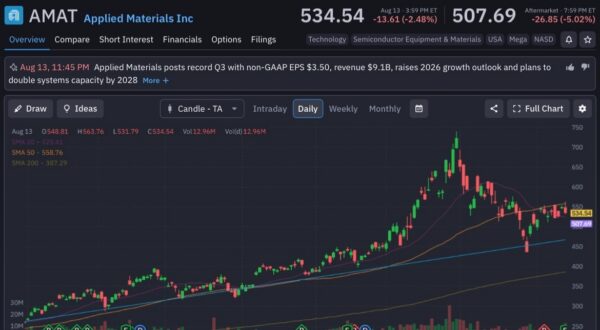
And yet, AMAT got slammed. Shares closed at $534.54, down 2.48%, before falling another 5.02% to $507.69 after hours despite the record quarter. The message is simple: investors are demanding enough growth to justify what is already priced into the stock.
But the bigger development isn’t that AMAT sold more equipment or that the stock sold off, by now, everyone knows it’s priced in. The elephant in the room is the Semiconductor Systems revenue climbing to $7.04 billion, while its non-GAAP operating margin expanded to 38.0% from 33.2% a year ago, showing that the spending tied to the complex chip manufacturing is becoming a larger and more profitable part of the business.
That takes us a step beyond the thesis from last quarter. We already knew AI was forcing chipmakers into more complicated manufacturing, advanced packaging and memory architectures. Now we’re seeing the financial payoff from that pressure land directly in AMAT’s numbers.
And management isn’t expecting the cycle to fade after Q3. It raised its outlook for 2026 growth and said customer demand visibility has improved enough to expect another strong growth year in 2027, particularly across DRAM, leading-edge foundry/logic and advanced packaging.
The manufacturing arms race we talked about last quarter is starting to look like a much bigger business for Applied Materials.
DRAM And Advanced Packaging Are Turning Into AMAT’s Growth Engine
The part I really like about this quarter is that the growth isn’t coming from some vague increase in “AI demand.” The areas of semiconductor manufacturing that AI is making more difficult are becoming a bigger part of AMAT’s actual business.
That lines up almost perfectly with the manufacturing problems we laid out last quarter. AI systems need more memory, faster movement of data and increasingly sophisticated ways of packaging chips together, which means chipmakers need more equipment to build them.
Applied is already positioning itself deeper inside that spending cycle, launching new systems for HBM, advanced packaging and 3D stacking, while Semiconductor Systems revenue reached $7.04 billion in Q3.
This is why I don’t see AMAT’s record quarter as just another strong semiconductor cycle. The mix is shifting toward some of the most equipment-intensive parts of the AI manufacturing buildout.
AMAT Is Making More Money From The Same AI Buildout
The stronger part of this cycle is showing up in the margins, because Applied Materials isn’t having to sacrifice profitability just to keep pace with the surge in equipment demand. Non-GAAP gross margin reached 50.4% in Q3, up from 48.9% a year ago, while non-GAAP operating margin expanded to 34.0% from 30.7%.
Semiconductor Systems is doing even more of the heavy lifting, with its non-GAAP operating margin reaching 38.0% versus 33.2% a year ago. Applied also generated a record $3.04 billion in operating cash flow and $2.33 billion of free cash flow during the quarter.
That combination makes the after-hours selloff harder to explain away as a deterioration in the business. The company is growing quickly, expanding margins and producing substantial cash at the same time.
There is still a valuation problem for the stock, though, and the market’s reaction may be telling us that record results are no longer enough on their own. Applied Materials now has to keep delivering growth at a level that can justify increasingly high expectations, particularly with management already pointing to another strong year in 2027.
Earnings Pop Became An After-Hours Selloff
AMAT’s chart is giving investors a pretty clear message – the fundamentals just got stronger, but the stock still has something to prove. Shares closed the regular session at $534.54, down 2.48%, before falling another 5.02% to $507.69 after hours despite the record quarter.
That reaction puts the $500 area on my radar, because a move back toward that level would erase a meaningful chunk of the recent advance and leave the stock fighting to regain its footing. The $550 area is the more immediate hurdle on any recovery, with the supplied chart showing the 20-day and 50-day moving averages around $549 and $559, respectively.
I wouldn’t read the after-hours move as evidence that the AMAT thesis has broken. If anything, the disconnect between the company’s numbers and the stock reaction is what makes the setup worth watching. Applied just delivered record revenue, record EPS, expanding margins and stronger visibility into 2027; the market simply wanted more.
Gold’s down $1,500 from its January high, and the crowd is sprinting for the exits. History says that’s a big mistake. Because even after the fall, gold still sits higher than it did a year ago — and a "crash" that leaves you up year-over-year isn't a crash at all. It's a breather. And a breather gives you a second shot at the miners that ran away from you in 2024 — the ones you swore you'd grab on the next dip. This is the dip. Don’t miss it.
I wouldn’t chase the stock after this reaction, but I also wouldn’t mistake a disappointing market response for a deterioration in the business. If Applied Materials can hold the $500 area and reclaim the $550–$560 zone, the chart can begin catching up with what the fundamentals are already telling us.
The AI manufacturing arms race is still accelerating, and Applied Materials remains one of the companies selling the tools needed to keep it running.



0 التعليقات:
إرسال تعليق