Ciena (NYSE: CIEN) delivered $1.67 billion in fiscal Q3 revenue, up 37% year over year, while adjusted EPS jumped 215% to $2.11 from $0.67 a year earlier. The company also raised FY2026 revenue guidance to $6.42 billion at the midpoint, or 35% growth.
Table of Contents
Those numbers already put a serious earnings beat on the table, but the more useful clue lies in where that revenue came from: optical networking generated $1.19 billion, or 71.3% of total revenue, compared with $815.5 million a year ago. Networking Platforms accounted for 81.1% of total revenue.
That makes CIEN more interesting than another company simply adding “AI” to its investor presentation. Ciena sells networking equipment that moves enormous amounts of data between the systems that power modern computing.
Now ask yourself – what happens when AI clusters become so large that the machines cannot all sit neatly inside one data center?
What Sam Altman's launching next could be 500 times bigger than ChatGPT, unlock an industry worth more than $1 million per American, and send one small group of stocks soaring as this news spreads.
For the last few years, investors have watched NVIDIA (NASDAQ: NVDA), cloud providers and data-center operators pour money into computing capacity, while the network connecting all those machines received much less attention.
Ciena’s Q3 numbers suggest that the networking bill is becoming impossible to ignore, as cloud-provider revenue grew 82% year over year and accounted for 53% of total revenue.
The company also highlighted rising demand for higher-speed optical connections and growing adoption of its WaveLogic 6 Nano technology, with 800ZR pluggable shipments more than doubling sequentially.
Think about what that means for the AI infrastructure trade. More GPUs create more computing power. More computing power creates more data movement. More data movement requires more bandwidth between servers, racks and data centers.
Ciena operates smack in the middle of that chain.
That gives us a more peculiar way to look at the AI boom. And that is, investors don’t need Ciena to win the AI software race or produce the next great model. It needs the companies building those systems to keep running into networking requirements that force them to spend.
The Margin Numbers Tell Me Customers Aren’t Just Ordering More
Ciena’s Q3 revenue growth would already deserve attention, but the profitability figures make it difficult to tag this quarter as a mere volume story. Adjusted gross margin reached 46.4%, compared with 41.9% a year earlier, while adjusted operating margin climbed to 22.5% from 10.7%. Adjusted EBITDA reached $411.1 million, up from $158 million.
Ciena also ended the quarter with $2.8 billion in cash and investments, while the company repurchased approximately 0.4 million shares for $171.7 million during the quarter.
Considering that a company can announce massive AI orders and still leave shareholders wondering whether those orders will ever produce decent returns, while Ciena is showing revenue growth alongside much stronger margins, this tells me the current demand is reaching the bottom line rather than simply inflating the top line.
And not only that, but the fourth-quarter outlook also keeps that momentum alive with expected revenue of $1.75 billion plus or minus $50 million and an adjusted operating margin of about 20%.
For a company selling networking infrastructure, that is the kind of financial trajectory I want to see as investors debate whether AI spending has gone too far.
Disconnection Between CIEN And The Business
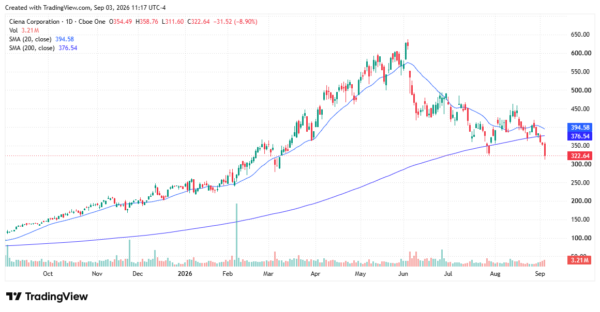
The stock has given investors a strange setup because CIEN has fallen from its June high near $620 to around $364, even as the company has produced stronger operating results.
That decline has left the stock below its 20-day moving average around $396.59, its 50-day average around $408.94, and its 200-day average around $376.75.
The chart still carries a descending trendline from the June peak, and CIEN recently tested the $350 area before bouncing toward $364. That leaves traders with a very clear fight.
If buyers push CIEN back above the 200-day average and then reclaim the $400 region, the market could start treating the recent decline as a reset rather than a change in the business.
If the stock keeps failing below those moving averages, the market is telling us that expectations still sit too high. I lean toward the first outcome because the fundamental picture gives buyers something concrete to defend.
Ciena Could Be One Of The AI Trades Investors Revisit
The easiest way to miss this company is to keep thinking of AI as a chip story, because Ciena’s quarter shows that spending eventually reaches the infrastructure surrounding those chips.
Ciena has 53% of revenue coming from cloud providers, optical networking producing more than 71% of total revenue, and management guiding to 35% FY2026 revenue growth at the midpoint.
The market can keep arguing about whether AI valuations have become stretched. With Ciena, however, I’m considering the possibility that the AI buildout will expand the amount of networking infrastructure required long after investors stop getting excited about another GPU announcement.
That is why I remain constructive on CIEN. The company sits in a part of the AI supply chain where spending has to become physical, and Q3 showed that customers are already putting real money behind it.



0 التعليقات:
إرسال تعليق