The race to build artificial intelligence has led tech companies to some surprising places. They have bought substantial amounts of chips, planned data centers and searched for enough electricity to keep them running. Now Google is looking somewhere farther away: orbit.
Table of Contents
Alphabet’s (NASDAQ: GOOGL)Project Suncatcher is exploring whether satellites equipped with Google’s AI chips could someday work together like a data center in space. The idea sounds futuristic because it is. Google describes it as a research project, with prototype satellites intended to test whether the hardware can operate in orbit.
The attraction is sunlight. AI computing needs a great deal of power, and getting that power has become a growing challenge for data centers on Earth. In the right orbit, Google says a solar panel could be up to eight times more productive than one on the ground and generate electricity nearly continuously. That could reduce the need for batteries and, in theory, give a network of satellites a steady source of energy.
The company’s plan involves Tensor Processing Units, or TPUs. These are the chips the company designs to handle AI workloads. Rather than putting a conventional data center building into orbit, Google is studying whether multiple solar-powered satellites carrying TPUs could be linked into a computing network.
Radiation and Heat Could Challenge Google’s Space AI Plans
Generating power in orbit would be useful. Keeping the equipment working there is another matter. A satellite and its chips must first survive launch. Once in orbit, the hardware faces radiation that can affect electronics.
Google says it has already begun testing how its TPUs respond to radiation, but a successful ground test does not settle every question about long-term performance in space. That is part of what the prototype mission is meant to investigate.
Then there is heat.
AI chips generate plenty of it, and space does not offer the airflow used to cool equipment in many Earth-based systems. Engineers would need a reliable way to move heat away from the processors so they can keep operating.
The satellites would also have to communicate quickly. One chip in orbit would be a small experiment. Google’s larger vision depends on many satellites sharing work across a network. If moving information between them is too slow, the available computing power may be much less useful than it looks on paper.
Finally, the economics must work. Satellites have to be built, launched and maintained. Hardware can fail or become outdated as newer AI chips arrive. Even if engineers prove that orbital computing works, Google would still have to show that it makes financial sense compared with expanding data centers on Earth.
Project Suncatcher Shows the Cost of AI Power
Tech companies are committing huge sums of money into AI infrastructure, while the eventual returns remain uncertain. If demand keeps growing, finding enough power and computing capacity could become even more valuable. If demand falls short of expectations, expensive projects may be harder to justify.
Space could eventually offer one answer, but the investment case is still years from being clear. The company first needs to prove its chips can work reliably in orbit, that satellites can exchange data effectively, and that the benefits are worth the costs.
For now, the most interesting thing about Project Suncatcher may be what it says about AI on Earth. When one of the world’s largest technology companies starts testing ways to run AI above the planet, it shows just how difficult the search for power has become.
Google’s research shows how far that search might go. Whether computing in orbit becomes a business or remains an intriguing experiment will depend on what the prototypes prove and whether the numbers eventually add up.
Tim Sykes says he opens his trading account every Monday to potential profits as high as $8,780, $9,177, even $16,000, thanks to a little-known loophole called the "weekend windfall."
Watch the 10-minute video that explains how it works.
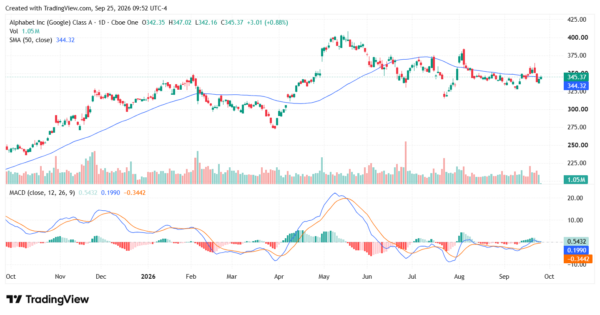
Technical Analysis: GOOGL Tests Key Support as MACD Turns Higher
As of this writing, GOOGL is trading around $345, putting the stock just above its 50-day moving average near $344. The technical picture has improved modestly after the September rebound, with the MACD recently moving back above its signal line and the histogram turning positive. That suggests short-term momentum has improved, although the stock remains below the $375 area reached during the summer and well below its roughly $400 peak in May.
The 50-day moving average is the first level to watch on the downside. A sustained move below it could put the September lows around $330 back in focus. On the upside, a move through the $350-$360 area would give the stock room to challenge resistance around $375. Overall, the chart shows consolidation rather than a decisive new trend.




0 التعليقات:
إرسال تعليق