A quarter ago, Microsoft Corp. (NASDAQ: MSFT) had a clear job to do. It needed to show that businesses were moving beyond experimenting with AI and making it part of their everyday operations.
Table of Contents
Its quarter one FY2027 offers a strong answer, with Azure revenue accelerating to 48% growth and Microsoft Cloud revenue reaching $63.9 billion. Yet as Satya Nadella’s company builds out the infrastructure to meet that demand, the cost of keeping customers supplied is rising alongside the revenue.
Anthropic — the maker of Claude AI — is preparing to go public.
Reports suggest its highly anticipated IPO could happen as soon as November. And its potential valuation could reach into the trillions.
But here's what's really exciting…
Anthropic's rapid growth has investors watching closely for what could become one of the largest technology listings in history. And some investors are exploring ways to gain exposure before the public debut.
Azure Is Starting to Show What AI Demand Looks Like
Microsoft’s first quarter of fiscal 2027 delivered $92.3 billion in revenue, up 19% year over year, while diluted earnings per share climbed 32% to $4.92. Operating income rose 21% to $45.9 billion, and net income reached $36.6 billion, up 32%.
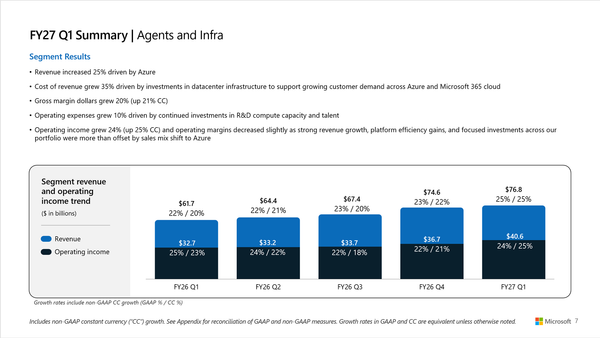
Those headline figures look strong, although the details tell us more about where the growth is coming from. The Agents and Infrastructure segment generated $76.8 billion in revenue, up 25%, with Azure leading the charge at 48% growth. Microsoft Cloud revenue increased 30% to $63.9 billion, supported by demand across Azure and Microsoft 365 commercial cloud.
I’m paying attention to how those businesses reinforce one another. Microsoft 365 commercial cloud revenue grew 17% on a reported basis, with higher revenue per user reflecting continued upgrades to premium offerings such as Microsoft 365 Copilot, E5 and E7. The company also reported increased consumption of usage-based services, primarily GitHub Copilot.
That is the kind of activity I wanted to see earlier. Customers can buy an AI product once and leave it sitting on the shelf, or they can use it across their daily work and generate ongoing demand for Microsoft’s software and cloud infrastructure. Higher revenue per user and increased usage suggest the second outcome is gaining ground.
Commercial remaining performance obligations provide another sign of demand. The company reported $677 billion in commercial RPO, up 73% year over year. Around 30% is expected to be recognized as revenue over the next 12 months, representing a 29% increase. The remaining portion, scheduled beyond the next 12 months, grew 98%.
That gives Microsoft a substantial pool of contracted business to work through, although commitments still have to become recognized revenue and cash. The next part of the results shows what it costs to deliver on them.
Business Growth And The Cost of Serving
Microsoft’s capital expenditures, including assets acquired under finance leases, rose 30% to $45.2 billion. Roughly three quarters went toward short-lived assets, primarily CPUs and GPUs, supporting Azure, Microsoft 365 cloud, research and development, and replacement of aging server and networking equipment.
Cash paid for property and equipment reached $39.4 billion, up 103%. Meanwhile, operating cash flow increased 29% to $58 billion, helped by strong cloud billings and collections.
That combination tells me Microsoft is generating substantial cash from its business while committing more of it to the infrastructure needed to keep growth going. Free cash flow, however, fell 27% to $18.6 billion as capital spending climbed.
I wouldn’t treat one quarter of lower free cash flow as proof that the AI investment is failing. The company is building capacity to meet demand that is already showing up in Azure revenue and customer commitments. Still, investors need to see that this spending produces enough recurring revenue and operating profit to justify the scale of the investment.
Microsoft Cloud’s gross margin percentage fell to 66% from 68% a year earlier, with management attributing the decline to a shift in sales mix toward Azure, partly offset by product-level margin improvements, primarily in Azure. That gives investors another figure to watch as cloud growth accelerates.
This changes how I view MSFT a little. Revenue growth is encouraging, and the contracted demand is substantial. The next test is whether the tech giant can keep expanding its cloud business without allowing the cost of serving that demand to consume too much of the financial benefit.
Nadella Has More Demand to Serve
The results were not equally strong across Microsoft’s businesses. Its Devices and Consumer segment generated $15.5 billion in revenue, down 3%. Windows OEM and devices revenue fell 22%, reflecting the prior-year benefit from Windows 10 end-of-support demand, channel inventory drawdowns, and weaker PC market demand. Search and advertising revenue excluding traffic acquisition costs grew 12%, providing some support, while Xbox content and services revenue declined 2%.
For Nadella, the challenge is to keep the fast-growing AI and cloud businesses expanding while the more mature parts of Microsoft’s portfolio face slower demand.
The next quarter’s guidance now gives investors a new benchmark. Microsoft expects revenue of $96 billion to $97.1 billion in fiscal Q2 2027, implying 18% to 19% growth, with Azure growth forecast at 49% to 50%. That outlook points to further acceleration in Azure, so the next report will need to show whether demand and profitability can keep pace with the spending.
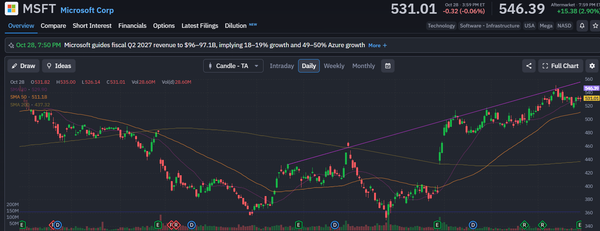
The market’s first response was encouraging. MSFT closed at $531.01 and traded at $546.39 after hours, up 2.9%. The close sat above the 20-day moving average near $529.90 and the 50-day average near $511.18, while the 200-day average remained much lower at $437.32. The move is a positive response to stronger cloud growth and guidance, though the next session will show whether buyers are willing to hold those gains. I’m watching whether the stock can stay above its recent trading range while Azure approaches the growth rate management has forecast.
All told, Microsoft has given investors more evidence that enterprise AI demand is translating into revenue. My view now depends on the next step: whether that growth can produce stronger cash generation as the infrastructure bill keeps rising. Azure is delivering the demand. MSFT still has to show how much lasting financial value it can extract from it.




0 التعليقات:
إرسال تعليق