Public Storage (NYSE: PSA) raised its 2026 earnings outlook after reporting $4.34 in third-quarter Core Funds From Operations (Core FFO) per share, up just 0.7% from a year ago. The self-storage giant has spent much of 2026 expanding its footprint, completing acquisitions of National Storage Affiliates and Public Storage Canada while positioning its operating platform to extract more value from those properties. The strategy gives Public Storage a larger business and a new source of growth. However, its established facilities are telling a much quieter story.
Table of Contents
Same-store revenue and net operating income (NOI) each grew just 0.5% in the third quarter, and management increased its full-year Core FFO guidance by only $0.10 at the midpoint. Public Storage is adding scale faster than its existing portfolio is generating organic growth, making the success of its acquisition strategy central to the investment thesis. The next phase depends on whether the company can turn those new properties into stronger earnings per share.
Public Storage’s Existing Business Is Barely Growing
The company generated $1.022 billion in same-store revenue during the third quarter, compared with $1.017 billion a year earlier. Same-store NOI reached $768.8 million, a 0.5% increase, while average occupancy improved from 91.9% to 92.2%. The operating picture is gradually improving, but the gains remain small for a business whose growth story increasingly depends on extracting more income from its real estate portfolio.
The pressure becomes clearer when expenses enter the picture. Direct operating costs increased 2% year over year, outpacing revenue growth, with repairs and maintenance expenses rising 17.4% and marketing costs climbing 12.5%. Lower indirect costs helped offset those increases, allowing NOI to edge higher, but the underlying portfolio has little room for error if expenses continue growing faster than revenue.
Management pointed to lower customer churn, higher occupancy and stronger move-in rates as encouraging trends. Those improvements helped the quarter come in ahead of expectations and supported the higher annual outlook. Yet Public Storage’s revised forecast still calls for same-store revenue growth of just 0%–0.5% and NOI growth ranging from a 0.8% decline to 0.2%.
That leaves the acquisitions carrying much of the growth burden.
The Acquisitions Need to Deliver More Than Scale
Public Storage’s non-same-store portfolio offers a sharp contrast. Revenue and NOI from these facilities grew 90.8% and 91.8%, respectively, during the quarter. This group includes acquired properties, newer developments, and facilities still progressing through lease-up, so its growth reflects the expansion and changing composition of the portfolio rather than a comparable surge across established locations.
The company completed its National Storage Affiliates acquisition in July and acquired Public Storage Canada in September for approximately $1.2 billion, including assumed debt. At September 30, Public Storage owned or operated 4,764 facilities with approximately 339 million net rentable square feet. Management expects the NSA acquisition to generate $110 million to $130 million in annualized synergies within three to four years through improved customer experience, higher NOI, tenant reinsurance, and general and administrative savings.
That synergy target is the key to the expansion thesis. Public Storage already has the additional properties; the financial payoff depends on integrating them and improving their performance. If the company can apply its PS Next operating platform successfully, acquisitions could become a more durable source of earnings growth. Until then, a larger footprint alone tells investors little about how quickly returns per share will improve.
Higher Guidance Has a Modest Earnings Upgrade Behind It
Now the full-year Core FFO guidance was raised to $16.90–$17.10 per share, increasing the midpoint by $0.10. It also improved its same-store NOI outlook by 90 basis points, reflecting better year-to-date performance and improving operating trends. The revision signals greater confidence in the business, but the limited increase in per-share guidance puts the focus squarely on how much additional value the expanded portfolio can generate.
GAAP earnings look considerably weaker. Net income per diluted share fell 35.5%, from $2.62 to $1.69, while transaction and integration expenses reached $114.6 million. Higher depreciation and amortization following the acquisitions also weighed on reported results. Core FFO excludes certain items, including acquisition-related expenses, and therefore offers a more useful view of recurring performance for this REIT. Even on that measure, however, quarterly growth was minimal.
Financing adds another consideration. Public Storage ended the quarter with $12.2 billion in total debt, while its weighted-average interest rate rose from 3.0% to 3.6% year over year. Net debt to EBITDA increased from 3.0x to 3.4x. The company reported approximately $4.1 billion in liquidity, but successful integration and stronger property-level earnings matter more as the balance sheet absorbs an expanded portfolio.
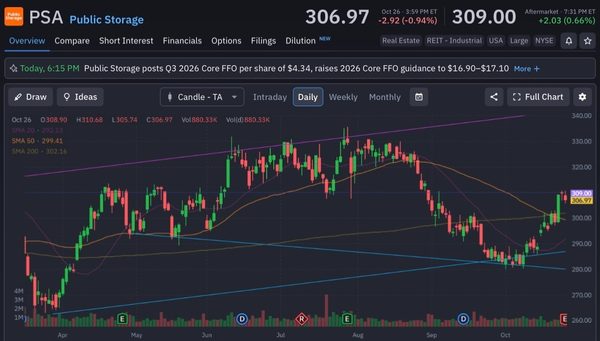
Public Storage closed October 26 at $306.97, with after-hours trading at $309. The shares have recovered above their 20-day moving average near $292, 50-day average around $299, and 200-day average near $302, putting the stock in a stronger position than it was during the September–October decline.
The immediate test is $310, close to the session high of $310.68. A sustained move above that level would strengthen the recovery and put $320 back in view. A drop below the $300–$302 area would weaken the setup and risk undoing part of the rebound.
Public Storage has expanded its footprint and raised its outlook, but the next leg of its growth story depends on what those acquisitions deliver. For investors, the number to watch is not simply how many facilities PSA owns, but whether that larger portfolio can finally produce faster Core FFO growth per share.




0 التعليقات:
إرسال تعليق