|
THE NUMBER
$44.6 billion.
That is the most Nscale's deals with Anthropic could be worth, says its amended IPO filing. The Nvidia-backed data center firm has no binding financing commitments yet for that work. In September, it told investors it had funding for at least a year, the Financial Times reported. Now it says it will need more money to meet what it owes in 2027. Nscale plans to list in New York, with no price range yet.
Here, the contract came first and the money has not.
PREMIER FEATURE
Stocks are at record highs. And everywhere you look, someone's predicting a crash. But Dr. Mark Skousen, the economist who told his readers to sell everything a few weeks before 1987's Black Monday, says they're missing what's really going on. "Something strange is happening today. You've probably sensed it." He says the next 12 months could make or break your retirement.
For the time being, his briefing is free. Watch it before it comes down.
THE SETUP
- Nvidia (NVDA) was quoted more than 2% lower before dawn, after six weekly losses in a row. It reports Tuesday after the close. Nasdaq-100 futures were down about 0.9%.
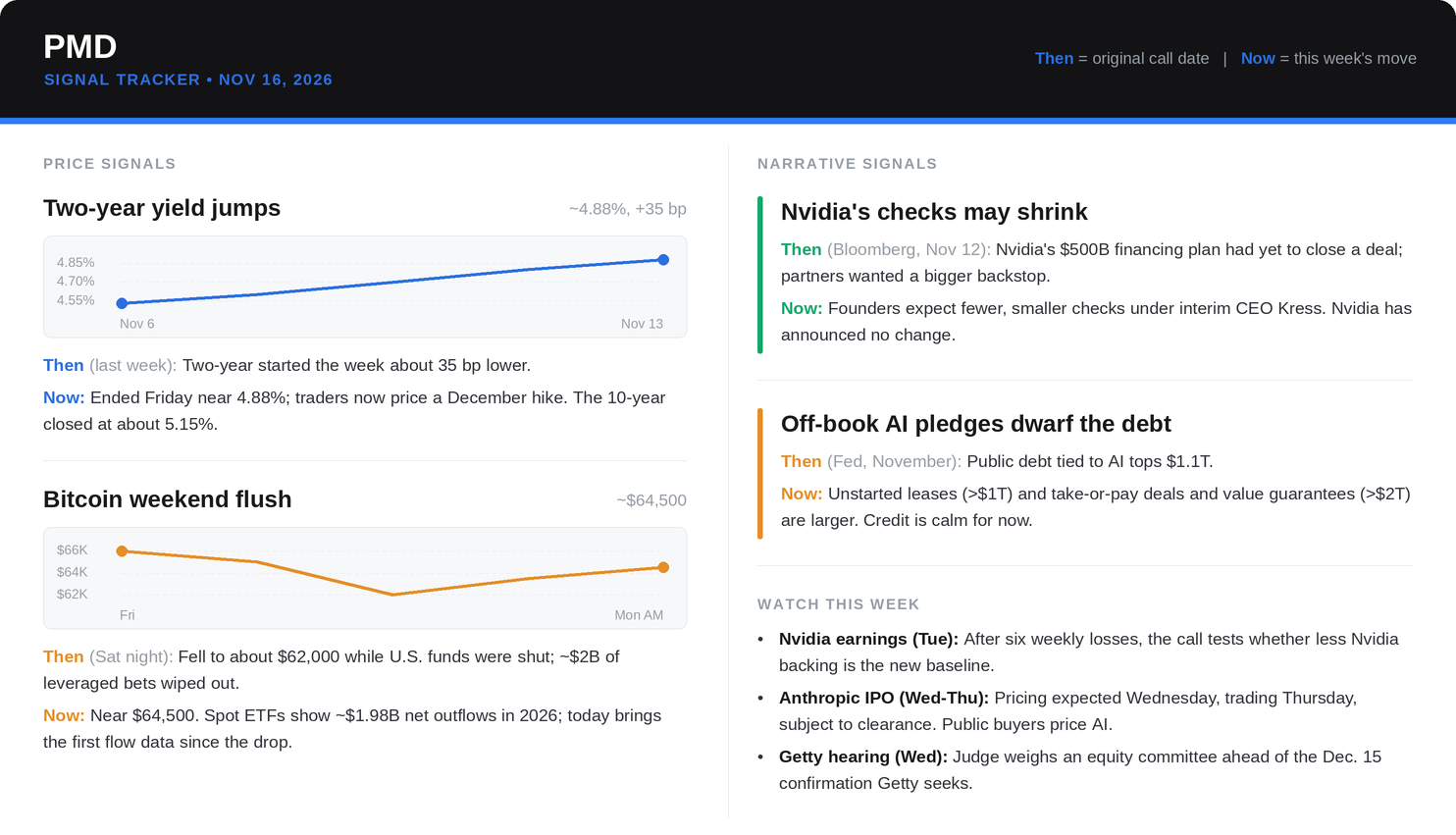
- The two-year Treasury yield rose about 35 basis points last week. It ended Friday near 4.88%. Traders now price a rate hike in December. The 10-year closed at about 5.15%.
- Fed Chair Kevin Warsh opens a San Francisco Fed conference at noon ET.
PMD Signal Tracker
IN FOCUS
Nvidia Was AI's Most Active Private Backer. Its Leadership Change Reaches Those Deals.
PitchBook data cited by TechCrunch show Nvidia took part in 105 venture rounds this year. It often wrote the largest check. Founders and backers told TechCrunch they expect fewer and smaller checks under interim chief Colette Kress. Nvidia has not announced any change. It also backs some customer deals with guarantees. Those help cloud firms borrow against their chips. Nothing reported so far shows the guarantees have changed.
As a backer, Nvidia's name in a round helps set the price. As a backstop, it helps firms raise money from lenders. If either role shrinks, startups lose an anchor and borrowers may find new guarantees harder to get.
Nvidia's $500 billion financing plan has yet to close a deal, Bloomberg reported Nov. 12. In August, Nvidia signed early pacts with six firms, including Apollo (APO), BlackRock and KKR. Final agreements are still needed. The aim is to raise over $500 billion of outside money over time. Bloomberg, citing people familiar, said partners and customers wanted a bigger Nvidia backstop.
Who Writes the Next Check?
For AI backers, a smaller Nvidia check or a thinner guarantee means others must put in more. The money matters because Nvidia's name has helped set prices in late rounds. Our read is that buyers will price new deals with less Nvidia support until Kress says otherwise. Tuesday's call would test that read, as would chip loans that close without an Nvidia backstop.
FROM OUR PARTNERS
The REAL Reason Trump Is Invading Iran
For a moment…
Forget about Trump’s ties to Israel.
Forget about reports of Iran’s nuclear program.
Because my research has led me to believe we’re risking World War 3 with Iran for a completely different reason.
Click here to find out what it is.
If you have even a single dollar invested in the U.S. stock market, this is going to directly impact you.
Discover the reason here.
SIGNALS IN MOTION
SIGNAL 1: The Fed Counted $1.1 Trillion of AI Debt. The Promises Off the Books Are Bigger.
The Fed's November stability report puts public debt tied to AI above $1.1 trillion. Signed leases that have not started top $1 trillion. Take-or-pay contracts and value guarantees top another $2 trillion. Those figures are not discounted.
These pledges are not debt. They sit off the balance sheets that lenders tend to watch, and in sum they are larger than the debt. Credit markets look calm for now.
WHAT RESOLVES THIS
For private credit and data center lenders, the risk sits in the pledges more than the loans. Money is at stake because a guarantee gets called when a tenant or customer falls short. The Fed does not call this a bubble. A first default on a data center lease, or wider spreads on chip-backed debt, would show the pledges being tested.
SIGNAL 2: Getty's Lenders and Noteholders Lined Up Against Its Shareholders. A Judge Hears Them Wednesday.
Getty Images and both of its main creditor groups filed objections late last week. All of them oppose an official equity committee. Under the plan, the Getty family and Koch Equity Development would get all the new equity. They would put in $433 million of cash and convert about $100 million of secured debt. Shareholders would get nothing.
Minority shareholders and warrant holders want the panel. They value Getty at $1.3 billion to $1.5 billion. By their count, shareholders would recover something only if Getty is worth more than about $1.46 billion, near the top of that range. The estate pays for an official committee. Without one, shareholders must fund their own fight over value.
WHAT RESOLVES THIS
For distressed debt buyers, this tests how far an insider plan can go when the wiped-out class has no paid voice. The money at stake is the valuation, since a higher one would give shareholders a claim. The hearing is set for Nov. 18, per 9fin, though an earlier notice said Nov. 17. A committee would make value a live fight. A denial could ease the path to the Dec. 15 confirmation Getty seeks.
SIGNAL 3: Thames Water's Creditors Plan a Bigger Equity Offer. The Regulator Has Not Said Yes.
Thames Water's main creditors plan to put in £3.5 billion of new equity in their next filing, according to reports. That is up from £3.35 billion in March. The figures are not final. The group holds most of the utility's roughly £20 billion of debt. It has not disclosed the size of the debt write-off or its members.
The plan also includes a larger write-off of existing debt. It would also limit dividends. If Ofwat and the government reject it, the alternative is special administration.
WHAT RESOLVES THIS
For infrastructure and distressed debt investors, this shows lenders paying more to become owners. Money is at stake because the new equity and the write-off both depend on Ofwat and the government saying yes. A third filing to Ofwat is expected around the end of November. If Ofwat moves ahead, it must consult for three months, and a court must sign off. Ofwat's response would show whether the extra money moves the plan closer to approval.
THE CROSSOVER
Private Market Trends Driving Public Market Moves
Nvidia's Checks Set the Price. Public Buyers Set the Next One.
Nvidia's checks and guarantees helped price private AI rounds and fund the chips behind them. Nscale has up to $44.6 billion of Anthropic work and no binding financing for it. This week, public buyers get a say. Nvidia reports Tuesday. Anthropic expects to price its IPO Wednesday and start trading Thursday, subject to regulatory clearance, its IPO website says. Our read is that private AI prices hold as long as someone with a balance sheet stands behind them. A weak Anthropic book or less backing from Nvidia would test that.
On the calendar...
|
When
|
Event
|
|
Mon., Nov. 16
|
Warsh speaks at noon ET; Getty replies due 4 p.m.
|
|
Tue., Nov. 17
|
Nvidia reports after the close; retail sales
|
|
Wed., Nov. 18
|
Fed minutes; Anthropic pricing expected (company)
|
|
Thu., Nov. 19
|
Anthropic expected to begin trading (company)
|
|
Tue.-Wed., Dec. 8-9
|
Fed meeting
|
Big Pharma Stopped Watching AI Drug Discovery. It Started Paying.
Sanofi has paid one AI biotech $144 million in upfront and milestone payments. Eli Lilly invested $40 million in another. Bristol Myers Squibb is putting a third company's AI co-scientist to work inside its own research organization.
The industry's biggest drugmakers used to watch this technology from the sidelines. Now they're customers.
We profiled the 5 companies leading AI drug development in a new FREE Special Report: AI Moves Into the Biotech Lab.
We'll text it straight to your phone.
Get the Free Report by Text →
|





0 التعليقات:
إرسال تعليق